Shim
Moon Seup

Harnessed From Nature

May 6 - September 30, 2026
Ca’ Faccanon, Venice

Shim Moonseup, Nature Sculpts

Sim Eunlog, Curator, AI Film Director

In dialogue with the 61st Venice Biennale, Shim Moonseup: Nature Sculpts unfolds at Ca’Faccanon (calle delle Acque, 30124 Venezia VE), the historic former post-office building near the Rialto Bridge, from 9 May to 22 November 2026. The exhibition traces the artist’s sculptural continuum through twenty eight works—painting, sculpture, and installation—drawn from his major series. Each piece marks a decisive moment within more than five decades of practice, from his debut at the 1973 Paris Biennale to new works completed in 2025.

Shim Moonseup has achieved international recognition through over thirty solo exhibitions in leading cities worldwide. Emerging from the late-1960s Korean Avant-Garde (AG) movement, he advanced the radical notion of “anti-sculpture,” a concept that resonated with contemporaneous currents such as Mono-ha, Arte Povera, and Land Art. As the first Korean artist invited to exhibit in Paris’s Jardin du Palais-Royal, Shim presented his works alongside Daniel Buren and Niki de Saint Phalle, imprinting Korean contemporary sculpture upon the global consciousness.

Throughout the 1970s he participated in the Paris Biennale three times in succession, later extending his presence to the São Paulo Biennale (1975), Sydney Biennale (1976), and Venice Biennale (1995, 2001). His artistic stature was further affirmed by the Excellence Prize at the 2nd Henry Moore Grand Prize Exhibition (Japan, 1981). In 2007, the French Republic recognized his lifelong contribution with the Chevalier of the Ordre des Arts et des Lettres.

Shim’s trajectory demonstrates how an artistic language grounded in Eastern philosophical contemplation can expand into a universal aesthetic discourse. Over time, his creative axis has shifted from the anthropocentric to the eco-centric, relocating the source of art from human agency to nature itself. The artist perceives within the prima materia—earth, stone, wood, light, and water—a latent current of prima energeia, the formative energy that animates all matter.

Here, nature ceases to be a passive material. It becomes an autonomous, self-generating presence. Shim positions himself not as a maker but as a condition setter, one who establishes the minimal circumstances through which nature may reveal its own formative intelligence. Hence the title does not imply that man sculpts nature but that nature sculpts.
Yet these works are neither untouched “ready mades” nor static displays of natural artifacts. They are collaborative processes, in which creation remains perpetually in progress. Shim’s sculptures inhabit the temporal field between formation and dissolution—works not concluded but continuously unfolding, as if nature were still sculpting in real time.

Prima Energeia and Reincarnation

In Korea, Shim Moonseup is primarily known as a sculptor; yet in recent years abroad, he has become more widely regarded as a painter.

However, from a young age he worked not only in three-dimensional forms, but across painting, photo-drawing, photography, sculpture, and installation—experiencing and employing an expansive range of material vocabularies and expressive methodologies.

His works may now be provisionally grouped into eight broad thematic fields, which will be introduced briefly in the sections that follow.

Through something on purpose

Lee U-FAN, Artist
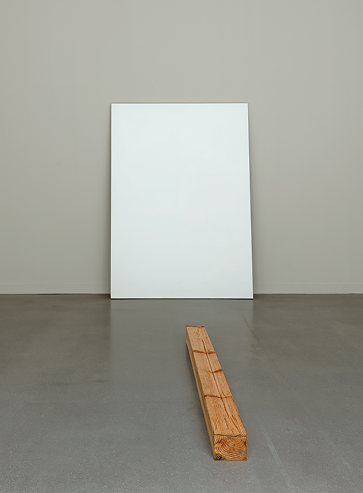
Relation (Circumstances),130x190x200cm, 1972, Canvas, Wood

Expression maybe something done on purpose.

I think of this when I have Shim Moon-seup’s works before my eyes. At a quick glance, his motifs and techniques are artful and plausible.

His works are there physically and logically as if they are necessary and the most natural in a certain situation or under the conditions of a certain time. Yet, a more serious look leads to the realization that everything in his works is so distorted that it makes spectators laugh. The artist did this deliberately: the works are mischievous, prankish. Maybe this artist is still playing naive tricks like the mischievous boy he once was. He might be paying the price of being a grown-up by playing those tricks in a sophisticated, metaphysical way. For example,he played with large pieces of paper, attaching them on the wall of a gallery, ripping the upper sides randomly, spread the ripped pieces on the floor of the gallery and placed several big and small rocks on them. He placed a huge canvas (size No. 100) on the wall and let several timbers slide upon the canvas, to scar the canvas. He also placed two large pieces of iron plate on the floor of the gallery, put several sacks of cement in the middle of the two iron plates, then pulled the plates apart slightly to distort this mountain of cement.

Everything in these works presents a delicate and stylish scene that is filled with a playful spirit. In this way, he was immersed in bringing about circumstantial situations: he used to present development of expressions of space. Since his visit to Paris, however, he started to take an interest in presenting circumstantial situations in terms of the time of actions. If an expression is something this artist does on purpose, it is no wonder that those expressions collide with nature.

The characteristics of this concept of collision are most apparent in terms of time, rather than in terms of space. Time is subject that slips by, but the artist is trying to advance time and to realize it into a pseudo-reality, in a bid to taste a reality that is infinitely open through distorted expression.

Shim would do this by, for example, tightly tying sacks or canvases on a frame and scratching the cloth of the frame with sandpaper or files to make it look old and wornout through friction. I haven’t seen this myself, but I’ve been told by the artist that he took large iron plates, crushed them, attached them on several frames and intentionally scratched
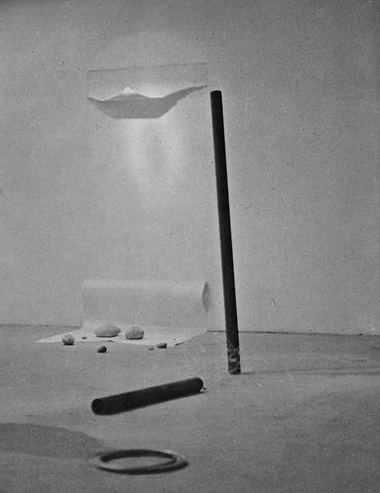
Relation (Place), 1973 (2017 remake) 300x148x135cm, Paper, Stone
the corners or edges with grinders as if they were worn out through long-term erosion.
Of course, his works are not all about abrasion: there are works where he developed methods for expressing space and time through creases. He mixed powdered marble and polyester to make a cylinder or tetrahedron, crushed or distorted the shapes in the course of solidification and then tried to straighten them out to restore them to the original state. As a result, the object comes to take a strange shape that is distorted in every way, crushed absurdly and solidified, and this becomes a striking reality that has no name.
Shim Moon-seup attempts to present situations in advance that occur in ordinary situations both in space and time without effort. Yet, we can not deny that these presentations circumstance, which appears to be natural at first glance, are actually a state where something is wrong and nonsensical, caused by a mischievous act that should not have occurred. Despite, or because of this nonsensical act, we come to understand an expression of the universe, where everything is properly presented, and it is quite interesting. Here we have this scene, which is
like something that happens in the world yet is somehow distorted and nonsensical, and this might be where there are all the meanings and characters of the actions that were conducted on purpose. There is a natural, intact sense of reality, which we cannot yet sense in our everyday lives, presented by the paradoxical and purposeful tricks of the artist.
There is a story about Sen no Rikyu, a celebrated Japanese tea master in the distant past. On an autumn day, he swept every fallen leaf from below a tree and spread a few of these fallen leaves below the same tree on purpose and enjoyed tea there. Maybe this is part of true creativity or expression. Sen no Rikyu put artificiality into nature, and, by doing so, made nature more natural and enjoyed it in a more human way. Expression is something we do on purpose. Yet, it is of course a beautiful and wise mimicry, in order to meet a greater world, not a willful imitation of the nature. It is acute mischief against nature and a very human form of expression. If expression is done only through the mechanism of force of habit or blunt techniques, it becomes a slave of an institution of style and pattern, and ends up being a disguise of the ‘contemporary art’ of the time.
Shim Moon-seup always takes pride in being an ordinary person who lives his life on the horizon of daily lives. His works are evidence of his desire to avoid highbrow art from other countries. What he wants is to discover the vivid universe from the myriad scenes hidden in everyday lives. Spectators get to stop and break into smiles because the artist presents distorted shapes and scenes on purpose, as if they were
supposed to be like that anyway, and as if there was nothing strange in that distortion. From an indifferent expression of things that are absurd and worthless, the artist finds a great perspective, and his artworks are his actions of absurdity, and spectators cannot help but smile. I heartily hope that this viewpoint of discovery, and this playful nature can lead to a world that is always fresh and ever craftier in its self-expression.
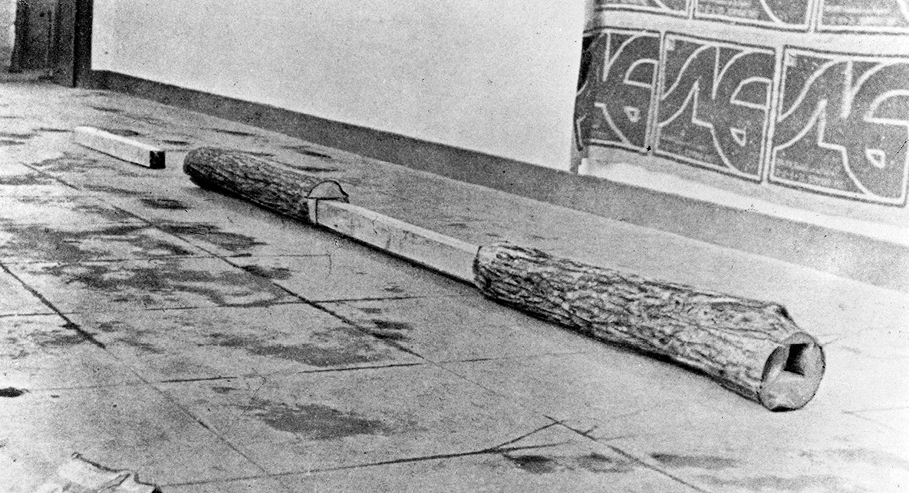
Relation(Place), 40x800x40cm, 1971, Wood

© 2026 Shim Moon Seup Foundation. All Rights Reserved