May 6 – September 30, 2026
Ca’ Faccanon, Venice
In dialogue with the 61st Venice Biennale, Shim Moonseup: Nature Sculpts unfolds at Ca’Faccanon (calle delle Acque, 30124 Venezia VE), the historic former post-office building near the Rialto Bridge, from 9 May to 22 November 2026. The exhibition traces the artist’s sculptural continuum through twenty eight works—painting, sculpture, and installation—drawn from his major series. Each piece marks a decisive moment within more than five decades of practice, from his debut at the 1973 Paris Biennale to new works completed in 2025.
Shim Moonseup has achieved international recognition through over thirty solo exhibitions in leading cities worldwide. Emerging from the late-1960s Korean Avant-Garde (AG) movement, he advanced the radical notion of “anti-sculpture,” a concept that resonated with contemporaneous currents such as Mono-ha, Arte Povera, and Land Art. As the first Korean artist invited to exhibit in Paris’s Jardin du Palais-Royal, Shim presented his works alongside Daniel Buren and Niki de Saint Phalle, imprinting Korean contemporary sculpture upon the global consciousness.
Throughout the 1970s he participated in the Paris Biennale three times in succession, later extending his presence to the São Paulo Biennale (1975), Sydney Biennale (1976), and Venice Biennale (1995, 2001). His artistic stature was further affirmed by the Excellence Prize at the 2nd Henry Moore Grand Prize Exhibition (Japan, 1981). In 2007, the French Republic recognized his lifelong contribution with the Chevalier of the Ordre des Arts et des Lettres.
Shim’s trajectory demonstrates how an artistic language grounded in Eastern philosophical contemplation can expand into a universal aesthetic discourse. Over time, his creative axis has shifted from the anthropocentric to the eco-centric, relocating the source of art from human agency to nature itself. The artist perceives within the prima materia—earth, stone, wood, light, and water—a latent current of prima energeia, the formative energy that animates all matter.
In Korea, Shim Moonseup is primarily known as a sculptor; yet in recent years abroad, he has become more widely regarded as a painter.
However, from a young age he worked not only in three-dimensional forms, but across painting, photo-drawing, photography, sculpture, and installation—experiencing and employing an expansive range of material vocabularies and expressive methodologies.
His works may now be provisionally grouped into eight broad thematic fields, which will be introduced briefly in the sections that follow.
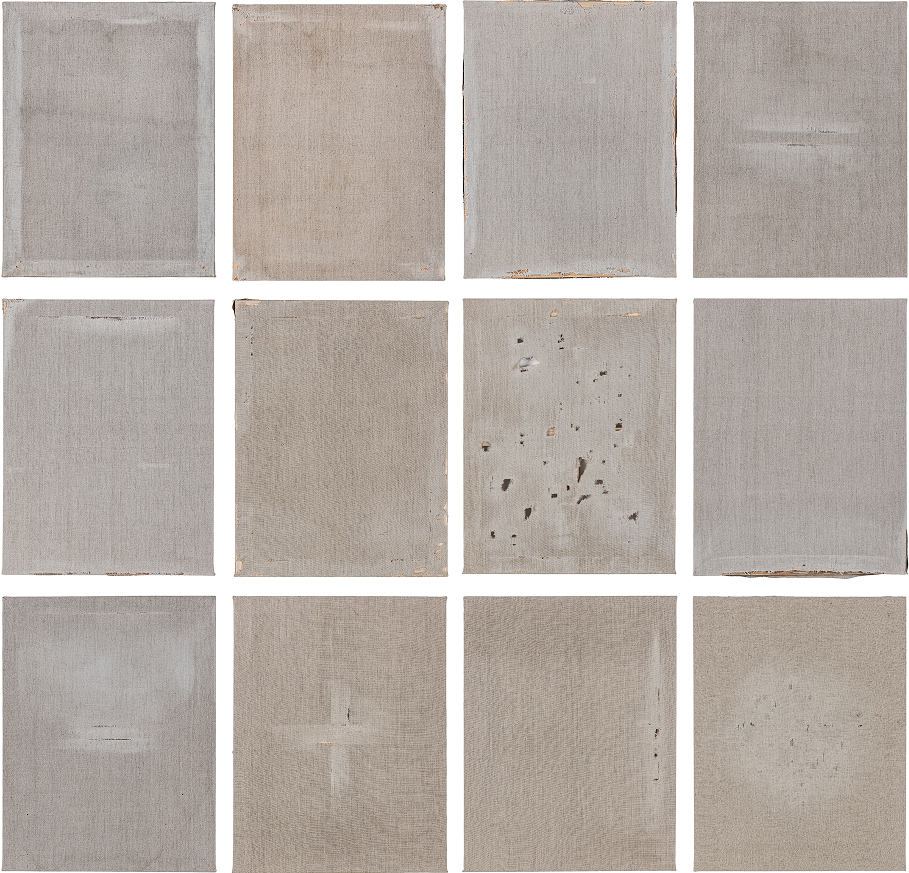
Opening Up, 60x50cm(4 pcs), 1975, Cloth, Sandpaper
Opening Up marks the critical threshold at which Shim Moonseup elevated time to the very essence of sculpture. Here, sculpture is no longer conceived as a discrete material form but as the trace, abrasion, and movement left by time itself. Through the act of sanding the canvas, he reveals that the erosion of time is not merely a physical effect but a sculptural principle.
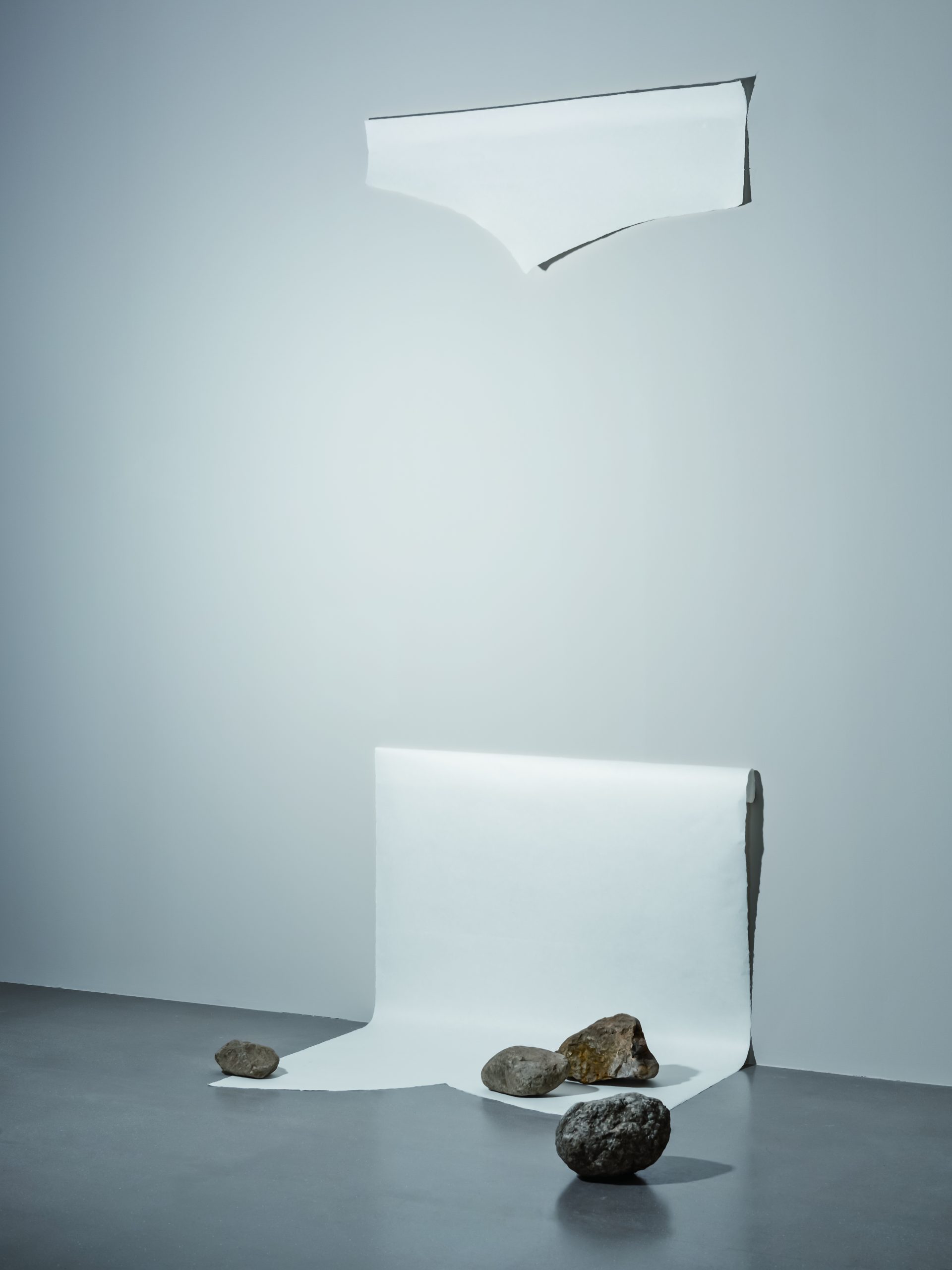
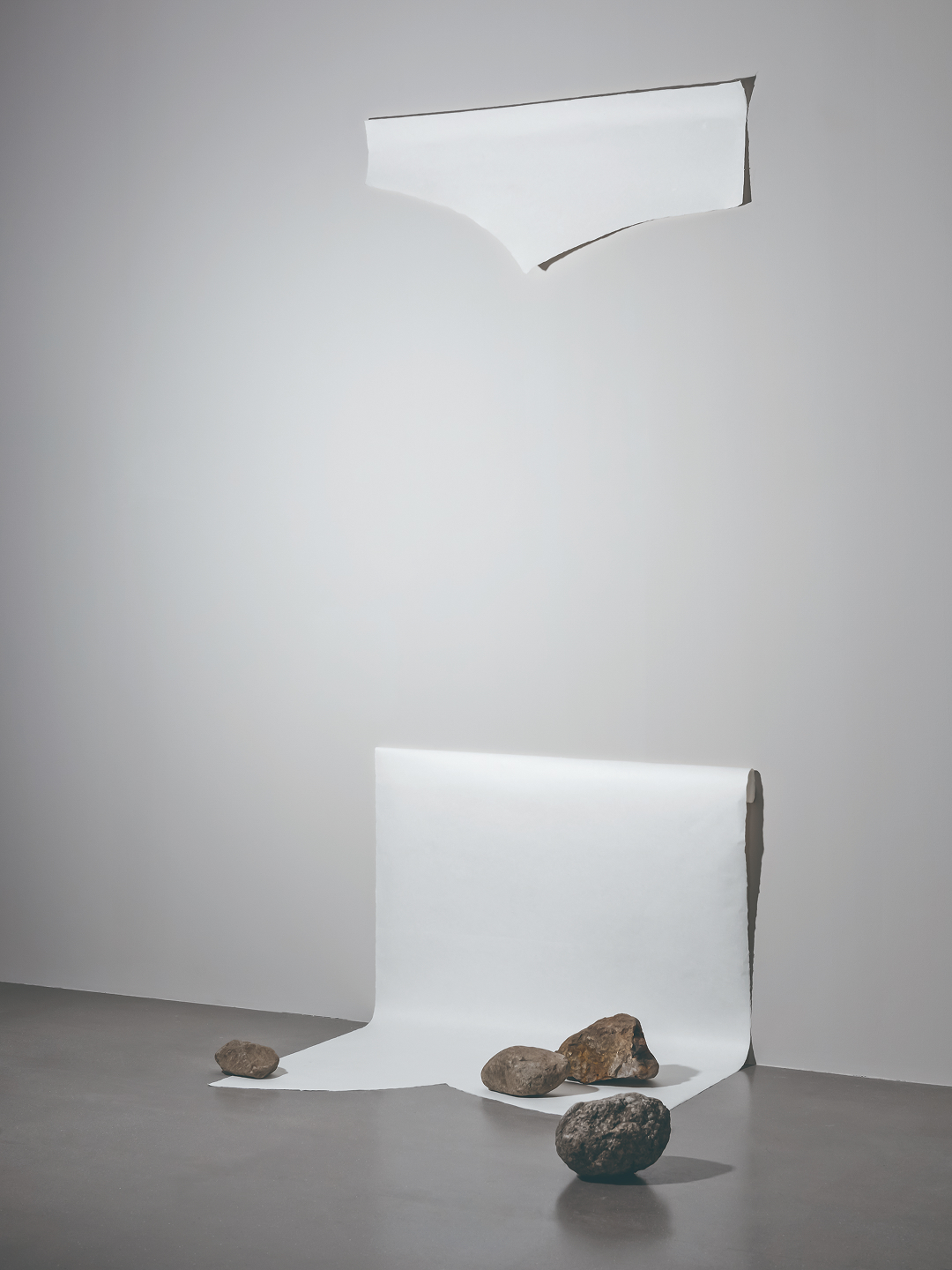
Relation(Place), 300x148x135cm, 1972, Paper, Stone (remake)
Relation(Circumstances 5), 300x165x330cm 1972, Wood, Canvas (remake)
In Relation , the torn paper, unaltered stone, empty canvas, and wooden supports together shift sculpture from a discourse of “object” (Seiendes) toward a discourse of “being” (Sein). Sculpture ceases to be a thing, and becomes a mode—a relational field constituted by intervals, resonances, and the charged space between elements. Relation is not a sculptural object; it is the way it stands, the way it is placed, the way it becomes a spatial constellation of gaps to be perceived. In Relation (Place), the act of tearing paper ruptures the premise of completion and perfection. This rupture is not a formal accident, but an event arising from relations between presences. It destabilizes anthropocentric sculptural logic and returns the site of thinking back to nature and matter themselves. Here, Shim Moonseup initiates a profound aesthetic shift toward an ontology in which meaning and form emerge from relational circumstance rather than authored certainty.
Thoughts on Clay, 1200x2400cm, 2010, Terracotta (Installation)
Thoughts on Clay, 28.5×28.5cm(4 pcs), 2002, Terracotta
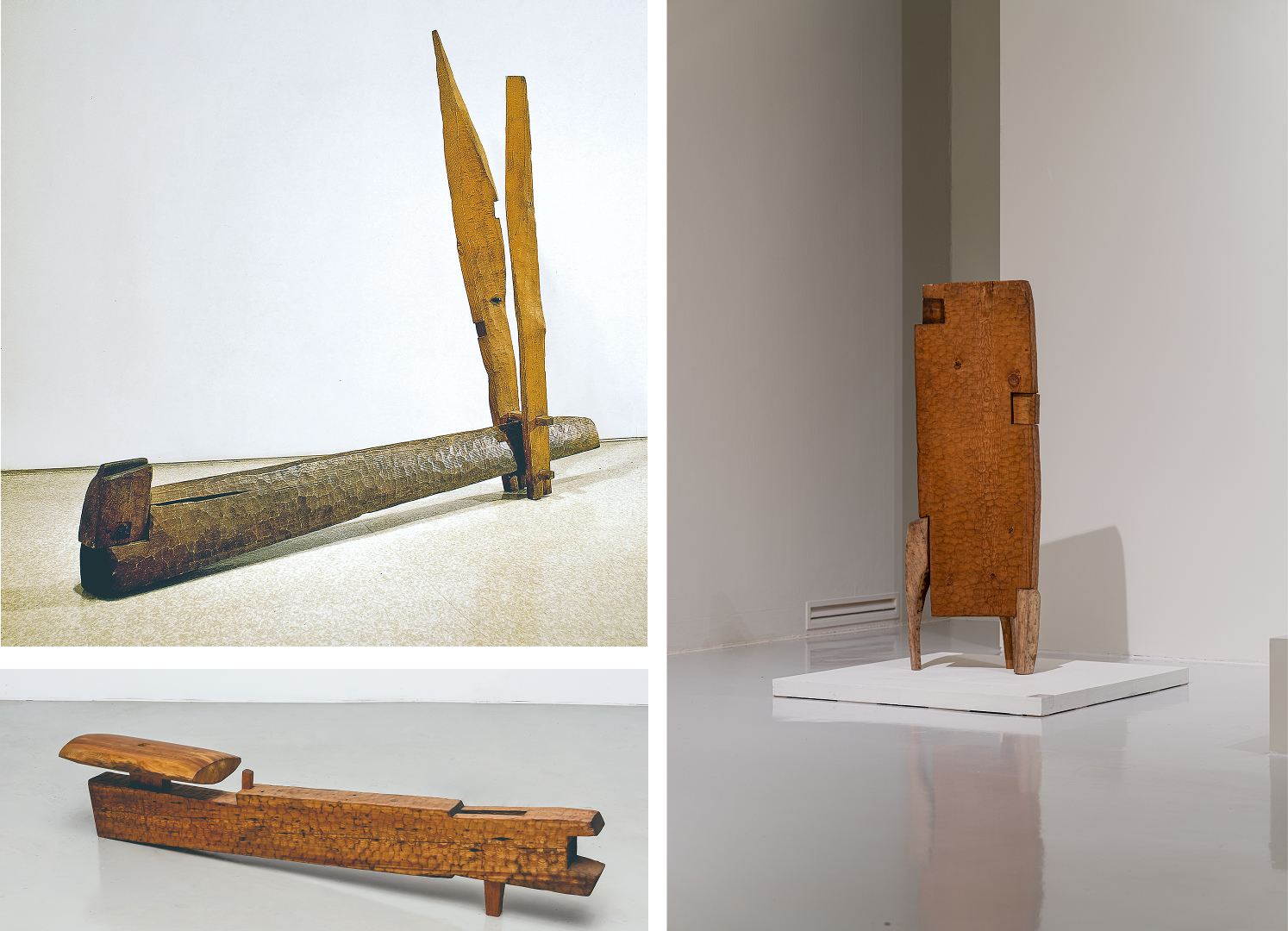
Wood Deity, 190x234x30cm, 1989, Wood
Wood Deity, 220x25x154cm, 1991, Wood
Wood Deity, 240x224x120cm, 1992, Wood
Most of the materials used in Wood Deity were reclaimed from wooden structures demolished during the extensive reconstruction projects for the Olympic preparations in Korea (1988) and China (2008). The artist does not mechanically process the wood; he allows its inherent rhythm to speak, permitting nature (自然) itself to articulate. The title “Wood Deity” does not imply a spirit inhabiting wood, but declares that wood—as an ontological being—is already sacred in itself. The aesthetics that arise from the slow rhythm of natural materials—wood, iron, stone—constitute a fundamental question, and a radical resistance, against contemporary visual culture governed by velocity and image saturation.
Metaphor, 172x102x33cm, 1996, Wood, Steel
Wood Deity, 40x192x27cm, 1986, Wood
Metaphor records the sculptural encounter, tension, and reconciliation between wood as the product of nature and steel as the emblem of the artificial. By placing heterogeneous elements in collision and adjacency, the artist seeks the possibility of “communion” and “interpenetration” that may arise between them. The juxtaposition of wood and steel visualizes conflict and reconciliation, contradiction and harmony—conditions that inevitably emerge through the coexistence of nature and humanity, antiquity and modernity. The work is itself a metaphor for the current epoch of technological and ecological transition
The Presentation, 180x306x153cm, 2008, Steel, Stone, Electricity
The Presentation, 147x306x153cm, 2001, Stone, Optical fibers
The Presentation discloses the passage of existence from prima materia to prima energeia. Shim offers elemental substances—stone, metal, water, fire/light, and void—within which time, memory, and life-flow become perceptible. Here, matter cannot be subordinated to the finite aims of the human. It appears as an autonomous and enduring presence that emits its own condensed time and energy.
Re-present, 230x202x65cm, 2025, Wood, Steel
Re-present, 245x262x150cm, 2010, Wood, Bamboo, Monitor
In this body of work, sculpture is not a fixed form but an exposure of relations in time, where multiple temporalities coexist. Shim Moonseup does not impose completion; he conducts the process, allowing the work to evolve through its own rhythm. The exhibited pieces are not static results but dynamic spatio-temporal fields, generating relations that emerge through the perception of the viewer and the fluidity of the surrounding environment.
The Presentation, 290x130cm, 2024 Acrylic on Canvas
The Presentation, 582x224cm, 2022 Acrylic on Canvas
The Presentation, 112x162cm, 2015 Acrylic on Canvas
It is the blue that most immediately and universally comes to mind when we imagine sky and ocean. If “Klein Blue” may evoke strangeness and enigmatic rupture, Shim Moonseup’s blue is instead familiar—a deeply imprinted, easily operative color of everyday memory. Thus, the spectrum of blue and white perceived by each
viewer inevitably varies according to the specific time and space they have lived through. And this is not limited to blue alone. Every color functions differently depending on the world one has experienced.
Through these congenial and resonant colors, the artist imbues the surface with rhythm and vital breath, revealing the ceaseless interchange of becoming and dissolution. As he notes, the painted surface is not a plane upon which something is merely depicted; it is a generative site in which the world briefly dwells. Shim continues to research and experiment so that painting itself may speak, may imagine, and may make us feel. This generative space is also the place in which contemporary viewers—living in the present—are compelled to dwell.
The Presentation, 800x200cm, 2024, Acrylic on Canvas
The Presentation, 160x160cm, 2025, Acrylic on Canvas
The Presentation, 117x80cm, 2024, Acrylic on Canvas
The exhibition title Nature Sculpts is not a rhetorical device but a sculptural declaration—an artistic response to the dual crisis of our time: the ascent of artificial intelligence and the planetary emergency of accelerating climate breakdown. We stand at a moment in which human authorship itself is challenged by machine cognition, while the Earth’s ecological system approaches cascading tipping points. Shim Moonseup confronts this threshold by posing a fundamental question: is the human the sole subject of art? Through this inquiry, he has overturned the dominant paradigms of sculpture.
His artistic philosophy resonates deeply with the thematic orientation of the 2026 Venice Biennale, In Minor Keys . Shim re-situates form not from the vantage of “center” but from the “periphery,” not from “progress” but from “slowness,” not from “will” but from “resonance.” His work recalibrates the relations between technology and nature, the human and the nonhuman, the subject and its environment—opening an ethical horizon for forms that emerge within
marginal senses and lesser-visible orders.
Shim’s aesthetic shift actively embraces the temporalities of becoming and flow, repetition and reincarnation, slowness and immersion. In this view, art is not a completed object but an event of resonance—occurring and dissolving within space-time. This sculptural sensibility aligns with East Asian philosophical thought—wu wei (無爲), emptiness (空), and responsive attunement (感應)—while offering a profound alternative to Western sculptural epistemologies.
In this exhibition, such philosophy expands into the entirety of the spatial field. The exhibition space is no longer a display container; it becomes a Generative Space, an Ecological Structure, and a Sensory Field in which nature itself operates as sculptural agent. The viewer is no longer a spectator evaluating form, but a participant within its resonance—co-creating the sculptural flow alongside nature.
Relation (Circumstances),130x190x200cm, 1972, Canvas, Wood
Expression maybe something done on purpose.
I think of this when I have Shim Moon-seup’s works before my eyes. At a quick glance, his motifs and techniques are artful and plausible.
Everything in these works presents a delicate and stylish scene that is filled with a playful spirit. In this way, he was immersed in bringing about circumstantial situations: he used to present development of expressions of space. Since his visit to Paris, however, he started to take an interest in presenting circumstantial situations in terms of the time of actions. If an expression is something this artist does on purpose, it is no wonder that those expressions collide with nature.
The characteristics of this concept of collision are most apparent in terms of time, rather than in terms of space. Time is subject that slips by, but the artist is trying to advance time and to realize it into a pseudo-reality, in a bid to taste a reality that is infinitely open through distorted expression.
Shim would do this by, for example, tightly tying sacks or canvases on a frame and scratching the cloth of the frame with sandpaper or files to make it look old and wornout through friction. I haven’t seen this myself, but I’ve been told by the artist that he took large iron plates, crushed them, attached them on several frames and intentionally scratched
Relation (Place), 1973 (2017 remake) 300x148x135cm, Paper, Stone