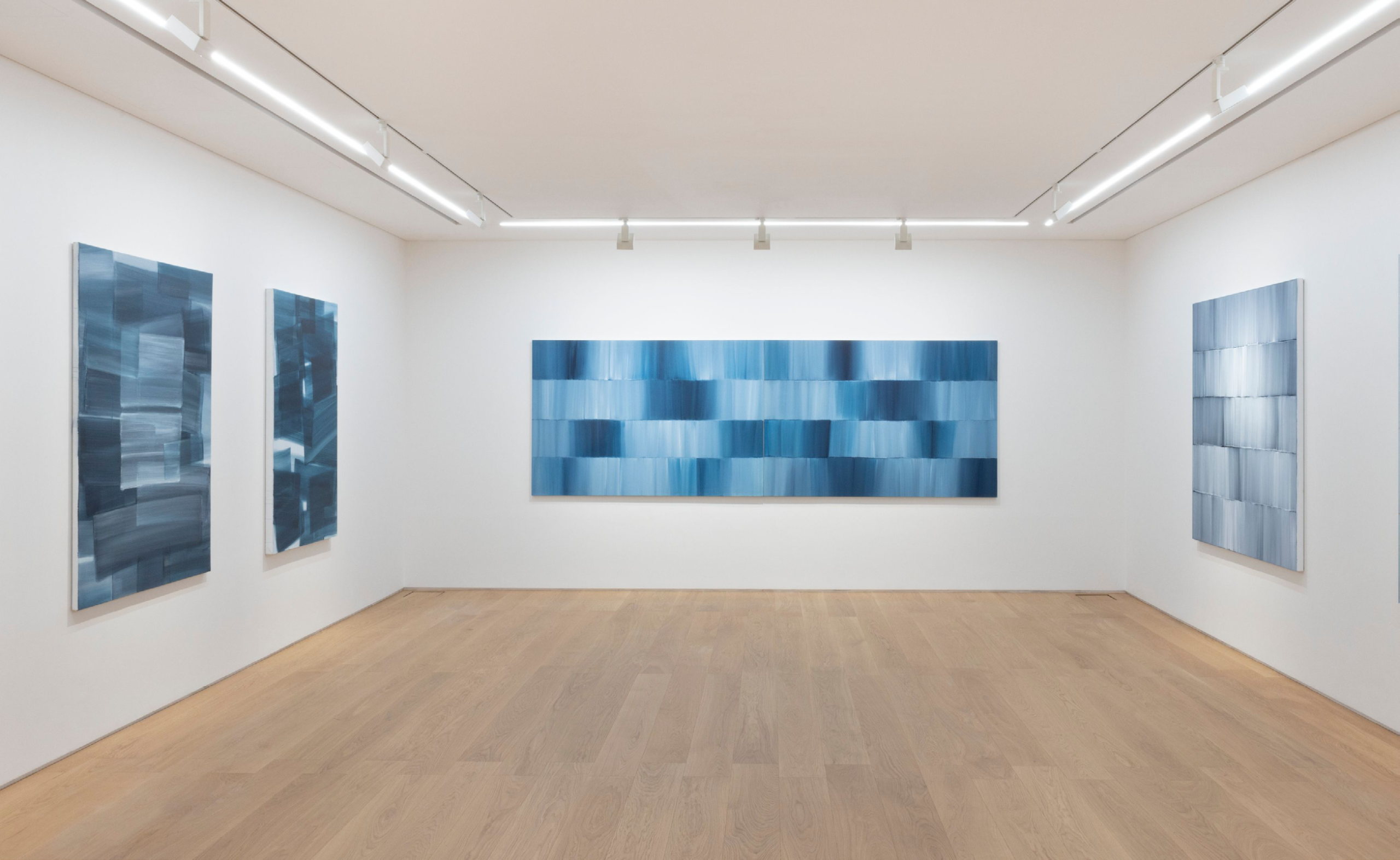
Installation view of “A Scenery of Time“ at Perrotin, Hong Kong, 2022. Photo by Ringo Cheung. Courtesy the artist and Perrotin
Steeped in Taoist and Buddhist thought, Shim Moon-Seup once declared his artworks “anti-sculptures” in order to express the energy and spirit embedded in natural materials. Born in 1943, Shim was active in the Korean art scene beginning in the mid-1960s, an era which saw artistic movements around the world, from Mono-ha in Japan to Arte Povera in Italy, Supports/Surfaces and Nouveau Réalisme in France, and land art in the United States join the broader political protest movements in opposition to war (in Vietnam and elsewhere), the military industrial complex, and the rise of consumer culture. Shim participated in the National Art Exhibition of 1969 to 1971 and became a member of the Korean Avant-Garde Association (better known as the AG Group) before going on to represent Korea at major international exhibitions of the day, including three editions of the Paris Biennale from 1971 to 1975, the Sao Paulo Biennial in 1975, and the 2nd Biennale of Sydney in 1976. He exhibited continually in Korea, Japan, France, and elsewhere in Europe throughout the 1980s, ’90s, and 2000s, and in 2017 Korea’s National Museum of Modern and Contemporary Art in Gwacheon organized a major retrospective for Shim titled “Sculpture of Nature,” curated by Park Soo-jin, as part of its Korean Contemporary Artist Series. In the last five years Shim has continued to explore his practice, particularly painting, which is where ArtAsiaPacific began this conversation with the artist.
Q: Your recent exhibition at Perrotin gallery in Hong Kong was titled “A Scenery of Time.” When did you develop a consciousness of time or temporality in your artworks? And how does the act of painting reveal properties or “the scenery” of time?
SHIM MOON-SEUP: At the 9th Paris Biennale in 1975, I began to incorporate the concept of time in my work, beginning with the suite of paintings Opening Up (現前) (1974–75), which means, in Korean, “something revealed in front of one’s eyes.” Using sandpaper, I rubbed the surface of the canvas until it was raw and worn. The element of “temporality” is morphologically exposed. I intended to reveal that the sense of time in Asia is interpreted differently than in the West. Time, along with space, is the most critical condition for us in order to understand all things in the world.
The title of my recent Hong Kong exhibition, “A Scenery of Time,” explains the relationship between time and scenery. The West measures time based on the sun, whereas Asia measures it based on the moon. Meanwhile, in the universe, time is measured by light. Before the Impressionists, western painters tended to erase leftover traces in their work that might reveal certain gestures or a physicality by using multiple layers of paint. In Asia, however, ink painting, especially calligraphy, reveals the painter’s gestures more bluntly by using materials like hanji (Korean mulberry paper) as well as brushes that express temporality. The beginning and the end of the stroke are evident on the paper. I paint with one stroke, as in ink painting, using every single brush tip with great sensitivity. At the same time I layer my paintings and repeat these continuous strokes, similar to the western process. In this way my paintings materialize time and light in the present, highlighting the “here and now,” and therefore are “a scenery of time.” As Chinese art critic Huang Du said, time and temporality are “invisible, abstract and poetic” in my paintings.
Q: Do you believe your childhood relationship with nature gave you a sense of time that is different from human time?
SMS: I was born in the southern coastal city of Tongyeong. As a child, the sea was my playground and I was fortunate to grow up as part of nature. The waves create an infinite rhythm of circulation and samsara by continuously repeating the action of creation and destruction through their rolling in and out. There, the eternity of the sea and the moment of a wave meet. It gave me a sense of time that is different from the western perspective, which is more human-centered. One day, having matured as an artist, I realized that the sea mirrored crucial elements within art and at that moment I understood that nature has different rhythms. My role as an artist is to capture these rhythms and present them to the viewer. There is nothing to add or subtract from the sea, where imagination and reality coalesce.
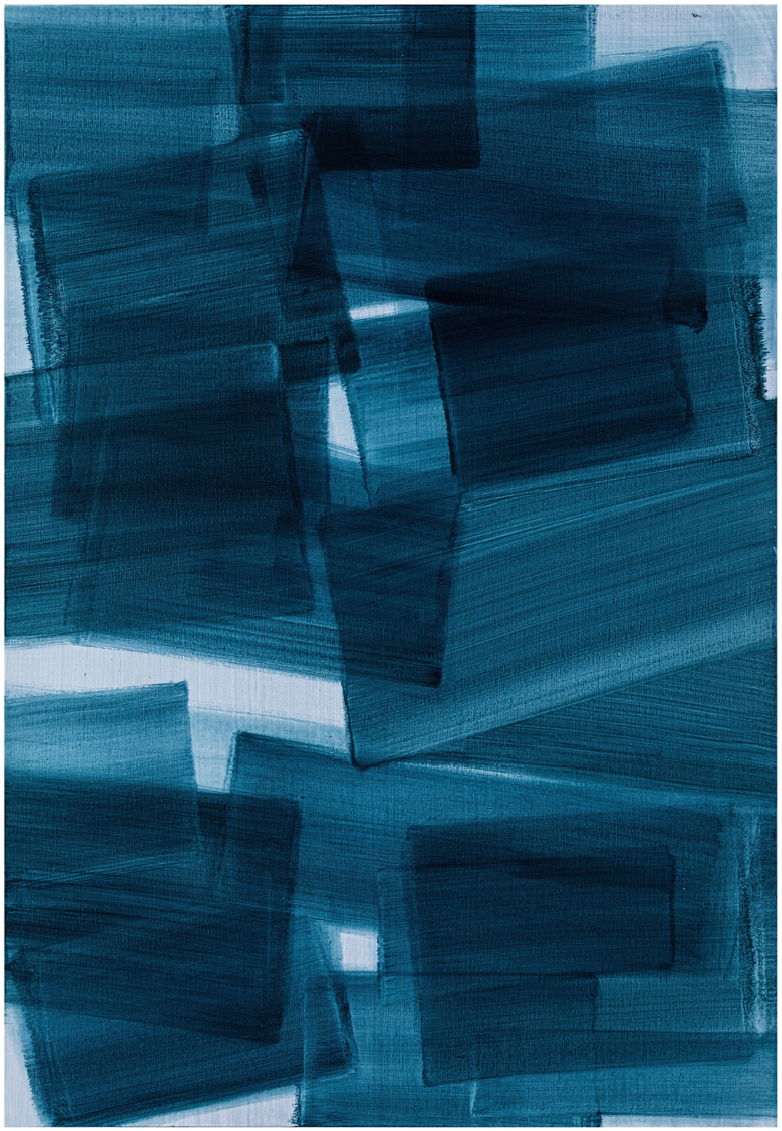
The Presentation, 2015, acrylic on canvas, 162.5x113cm.
Courtesy the artist and Perrotin.
Q: Your works are considered “anti-sculpture” for your use of iron, cement, and soil, among other materials. Can you tell us about the importance or meanings associated with raw materials (like wood, stones, or clay) to you and your generation ‘of avant-garde artists in the 1960s and 70s?’
SMS: Having contemplated on my participation in the late 1960s with the group known as the Third Formative Association, which called for a new concept of sculpture, and the AG (Avant-Garde) movement in the ’70s, I proposed my concept of “anti-sculpture,” which coincided with art movements like Arte Povera that took place around the world in those decades—though we did not have much information about these trends at the time. Lee Ufan, one of the founding members of Mono-ha in Japan, was very active as an artist and art theorist and he had a great influence on me. Theologically, I was influenced by a circulation of natural philosophy from the Taoism (道家思想) and the concept of samsara, based on Zen (禪) Buddhism.
The title of my recent Hong Kong exhibition, “A Scenery of Time,” explains the relationship between time and scenery. The West measures time based on the sun, whereas Asia measures it based on the moon. Meanwhile, in the universe, time is measured by light. Before the Impressionists, western painters tended to erase leftover traces in their work that might reveal certain gestures or a physicality by using multiple layers of paint. In Asia, however, ink painting, especially calligraphy, reveals the painter’s gestures more bluntly by using materials like hanji (Korean mulberry paper) as well as brushes that express temporality. The beginning and the end of the stroke are evident on the paper. I paint with one stroke, as in ink painting, using every single brush tip with great sensitivity. At the same time I layer my paintings and repeat these continuous strokes, similar to the western process. In this way my paintings materialize time and light in the present, highlighting the “here and now,” and therefore are “a scenery of time.” As Chinese art critic Huang Du said, time and temporality are “invisible, abstract and poetic” in my paintings.
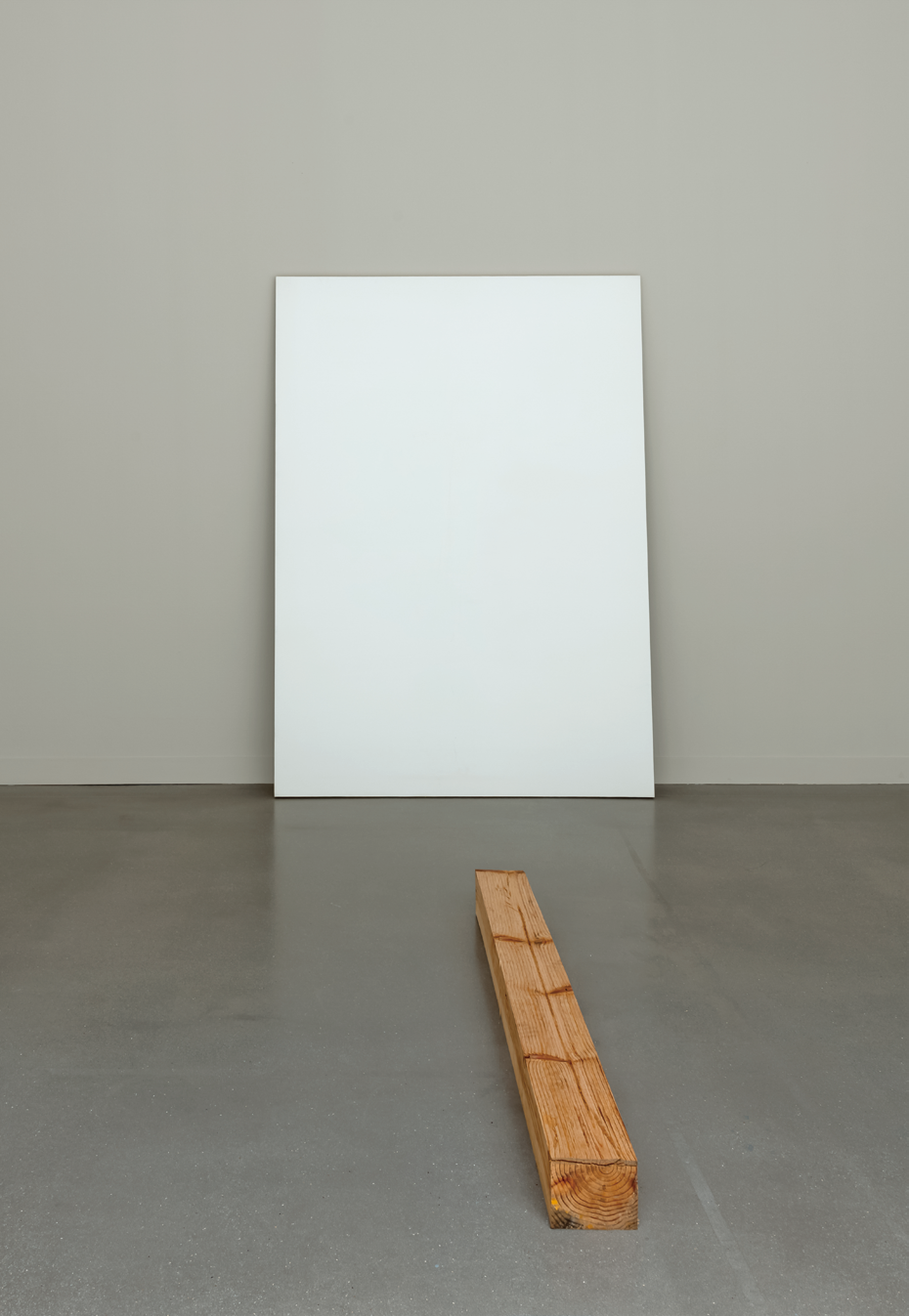
The Presentation, 2015, acrylic on canvas, 162.5x113cm.
Courtesy the artist and Perrotin.
Q: Do you believe your childhood relationship with nature gave you a sense of time that is different from human time?
energia (運行原構), the circulation of natural energy, or samsara, through these materials.
The presentation of raw materials was the result of my “anti-sculpture,” in which I gave up object-oriented creation based on the artist-centered perspective. I tried to minimize the artist’s interventions. The idea is to talk less, make the material speak, and listen to the inner sounds of the matter. The materials expand the surrounding space and invite us into an imaginary world that cannot be seen as it overlaps with reality. After that, the things that could not be understood develop into transcendental matters. In this way, I constantly strive to reveal the unique properties and structure of the material through continuous questioning and experimenting into the existence of materials. Whether these are “anti-sculptures” or “non-sculptures” is ultimately up to critics.
Q: What is the place of the artist in the human-nature relationship? Do you see artists as translators of the spirit of nature, or can artists help us understand our relationship to nature?
SMS: Nature (自然) is both what it is and as it is. Being as a fact, being as a living thing: this is nature. Nature is not a silent outsider, but a companion of humankind with an active voice. Humans and nature are both part of the integrated structure of the ecosystem. The artificial structures in cities are dead creatures that do not breathe and do not have self-sustaining energy. On the other hand, natural elements that have vitality are constantly evolving. I often work on the subjects of organic relationships, circulations, and changes of these ever-evolving natural elements.
Oscar Wilde once remarked that before Turner there was no fog in London. I believe the artist’s role is to encourage people to recognize something they may not previously have paid attention to. It’s important for artists not to show anything indiscreetly, but instead reveal things that are worth looking at based on the temporal and spatial conditions of the time. German philosopher Martin Heidegger said that scientists turned flowers into objects for analysis and poets turned them back into flowers again.
In relation to the environment and the climate crisis, one of the important roles of the contemporary artist is to make nature visible as a living entity. I was able to experience nature early in my life, and this encounter was both poetic and aesthetic. An artist is someone who reinterprets and “re-presents” the world through certain encounters. I hope that viewers and artworks can harmonize to create a site where objects, materials, and people can coexist.
Q: In the Relation series from the 1970s you carved part of a tree into a plank but left parts of it uncarved, showing how material can become form. Were you searching for an essence of sculpture in those works, or were you trying to change the perception of sculpture from the form of a human figure to its raw materiality?
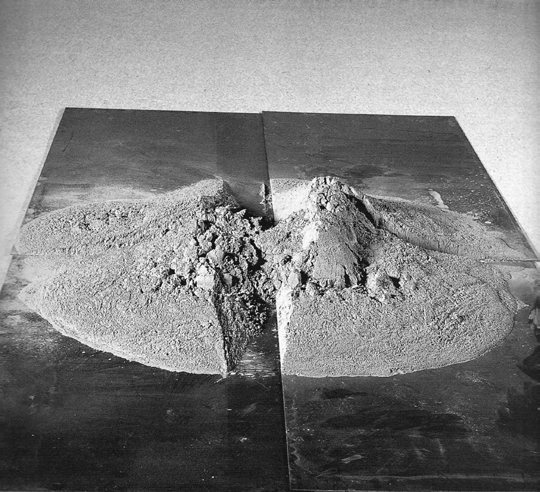
Relation (Placement), 1972, iron plates and cements,
48x354x172cm. Photo by the artist. Courtesy the artist.
SMS: Over the centuries artists have carved marble or wood from a human-centric perspective, and in the process revealed only human shapes and thoughts. But I wanted to reveal the raw material itself from the perspective of nature and thereby minimize the artist’s hand. In this way, the materiality of the original raw material and the perspective of nature are better revealed. I often use the expression “borrowing landscape (借景),” which differs somewhat from Marcel Duchamp’s idea of the readymade. “Borrowing landscape” means to borrow from Mother Nature. It implies that it should be returned, as it is not possessed by anyone. For example, I once borrowed and abandoned wooden structure. These were wood blocks, beams, pillars, doors, or supporting woodblocks that retain scenes and stories and yet they had been discarded because they were considered “useless.” I helped revive their original essence while also calming them down, because sometimes wood can be too assertive! I make them compromise with each other and harmonize with their surroundings. My sculptures are not complete pieces, rather they change according to their surroundings. In this way they evoke a primitive life closer to nature.
Q: Opening Up began with works on canvas that you sanded to reveal aspects of the stretcher and the surface, as if they had become weathered. The series then evolved into cut wood plates, then slabs of clay, which you broke open. Were the tactile concepts of energy or spirit and the understanding of fundamental materials ideas you wanted to explore in these works?
SMS: The term “opening up (開闢)” originates from Zen (禪) Buddhism and means a certain fact is being revealed on its own in the process. In my series, Relation (1972) and Opening Up (1973–1993), I began to question the concept of Qi (氣), in both Taoism and inside the materials themselves. If the artists in the West tended to emphasize the physical materiality of elements, artists in Asia focused more on the process of creation through the inheritance and mutation of the aforementioned five elements. It is “temporality” that reveals this phenomenon, and I saw that energy as Qi, which is regarded as the most important element in the history of Asian art.
For my work Opening Up, the canvas fabric was stretched tightly to the frame. I then rubbed the edges and the middle with sandpaper with the intention of accelerating the material’s process of fading over time to make it appear worn out. Historically, in Western painting, depictions of memento mori, or, for example, the series of Rouen Cathedral paintings by Claude Monet, time was dealt with metaphorically and, again, from a human perspective. I believe Opening Up was the first artwork of its kind that deals with the essence of time itself in relation to the objects of art.
In The Geography of Thought (2003), Richard E. Nisbett describes Asian thought as circular whereas Western thought is linear. “Circular (圓)” can mean circulation or samsara (the doctrine of reincarnation), but above all, it means “relationship.” The Relation series was created with this in mind.
Q: In the Wood Deity (1982–94) series you employed more carving techniques and composed the sculptures out of different elements. As a result, such sculpture is very dynamic. How did you compose these forms? And did the sculptures’ forms derive from properties of the wood itself?
SMS: The title of the series refers to the idea that the spirit breathes in wood. Compared to other materials, wood is close to humans. And although the artist’s presence is visible, the wood is often acting independently. As I carve the wood there is a rhythm that repeats, and I feel music in the subtle changing patterns. I hope that sense of the rhythm of the wood spreads to viewers, and the sense of living together with the wood, while delicately changing its tone, seeps into my work. Most of these works are made by connecting multiple pieces of wood. This tends to weaken it because the wood exerts an absolute force, and even split branches or pieces eaten by insects are used. There is a rough plan for production, but I try to consider the characteristics of the wood to leave it as unfinished as possible by simply not interfering. From the moment I stop creating, the “Wood Deity” begins to move freely, warmly, and maybe playfully.
Q: In the Re-Present series (2001–17) is more varied in terms of the materials you used: wood found objects like wood clamps, light volumes, a shipping container, even a monitor or carpet in some cases. It feels like you are challenging viewers to reconsider what is a “raw” material. Do you think your own understanding of raw material or sculpture has changed over time?
SMS: Just like the Obangsaek (five basic colors) and Obang-gansok (five complementary colors) in traditional Korean culture, there are also other materials that are often used to support the primary “raw materials,” depending on the temporal and spatial conditions of the creation and exhibition of the artwork. Additionally, I frequently use materials considered immaterial—such as air and light—alongside natural materials. Since the 2000s, I have employed not only visual elements but also tactile and auditory elements in my work. My understanding of the raw material of sculpture has changed over time and depends on the central material that I am working with. Rather than try to conform the sculptural material to myself, I try to adjust myself to the material. For my works in my wood, like the waves I mentioned earlier, water flows and returns. The circulation of water symbolizes the system of reincarnation and continuity without beginning or ending as a motif that connects the flow of life.
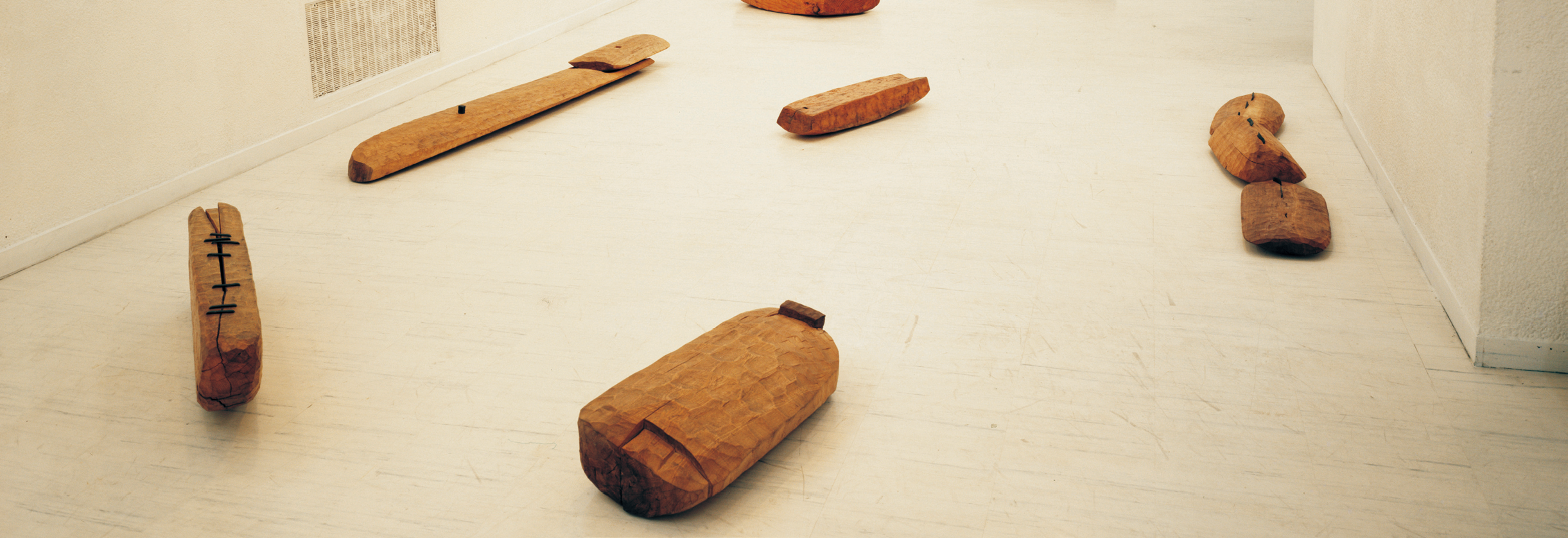
Installation view of “Wood Deity” at Tokyo Gallery, 1985. Photo by
Tokyo Gallery. Courtesy the artist and Tokyo Gallery.
Q: How did you start painting again, after so many years of working with heavy materials, especially wood in the Re-present series?
At the Paris Biennales in 1973 and 1975, I created planar works in three dimensions with paper and canvas, respectively. Since then I have continued to expand my work in various ways, without being confined to the categorization of sculpture or painting. In a narrow sense, the term “anti-sculpture” is limited to the field of sculpture, but in another sense, it extends to the realm of painting, which is the opposite of sculpture. More accurately, sculpture and painting are not separate worlds are complementary. For me, creating art is a course that involves finding a question based on the image experience and memory of my inner self, and searching for answers. Painting is another question that arises for me. As mentioned earlier, water flows inside my sculptures, and expressing this incorporeal water visually is also a series of processes.
Q: What are your wishes for the future existence of your artworks?
I consider materials that contain temporality or energy and the works that include a body’s physicality through the direct interaction with these materials are desperately needed in the current era of Web 3. I hope that this generation and their descendants will continue to experience this kind of materiality and physicality through my works. As an anti-sculptor I have engaged in a fierce struggle to go beyond the Western logic of sculpture. I needed a contemporary response to the concept of sculpture and have sought art that is not bound by identity—that is, art that does not stay in one place. In addition, poetic resistance was necessary to go beyond institutional authority, and I have maintained an “anti-sculpture” attitude of looking at sculpture as an outsider. I have not abandoned the function of my hands either. I will continue to pursue deviation from established genres and nurture myself as an anti-sculptor and non-sculptor, sailing through time.