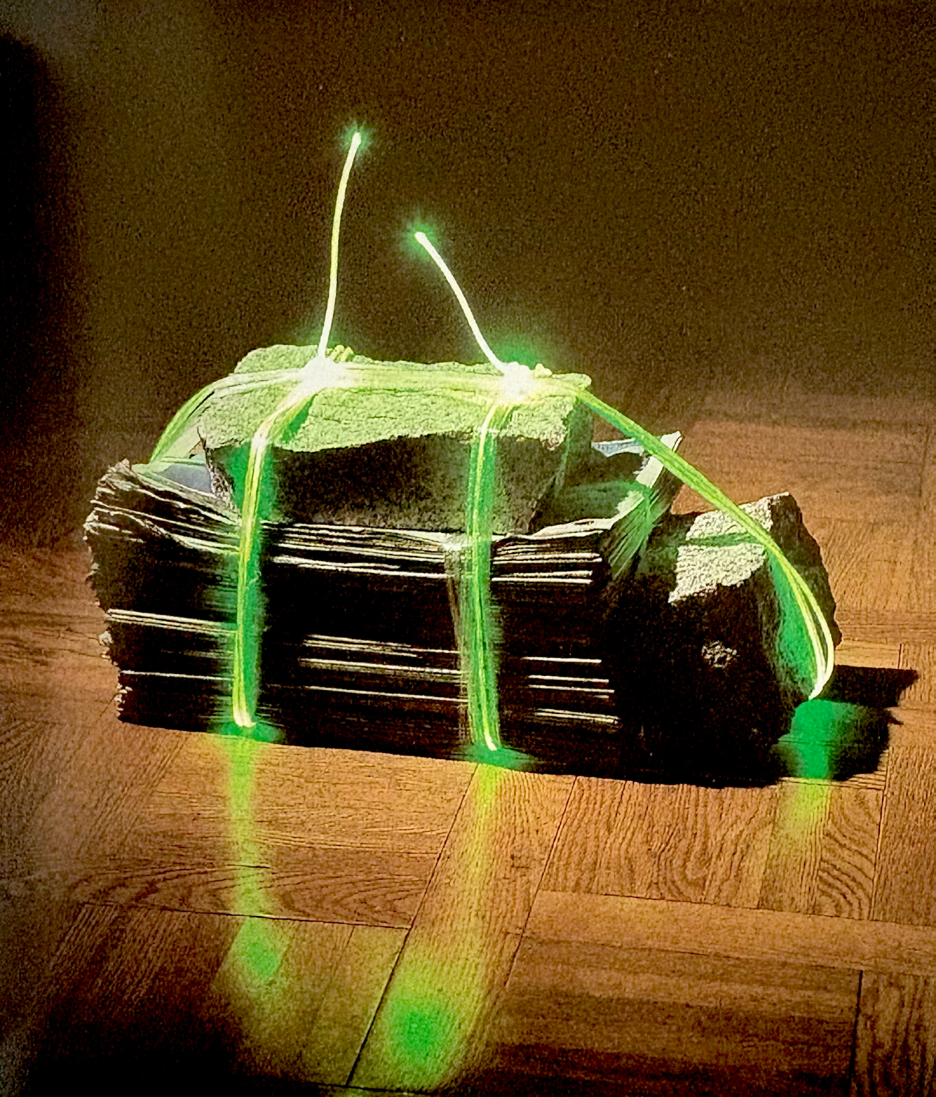
The Presentation, 350x52x320cm, 2001, Newspaper, Optical fiber
The works of Shim Moon-seup are simple because they relate to things in the simplest possible way. It is a matter of sculptures that, in their simplicity, often combine two forms, two materials, two signs, and two symbols. And yet it is precisely the articulation of this simplicity which enables the Korean artist to organize the complexity of a sculpture that crosses the borders of sculpture as a genre and (at the same time) retraces them, along a line where the roots and plots of the part of history of sculpture which has changed its significance and retraced its practice to the primary canon are intertwined.
We are referring to the line of the recent history of sculpture which, beginning with Constantin Brancusi and Julio Gonzales, arrives at the Minimalism of Carl Andre and Joel Shapiro, the Land Art of Robert Smithson and Walter de Maria, the Arte Povera of Giuseppe Penone and Giovanni Anselmo, and finally the singular practices of Joseph Beuys, Richard Long, Luigi Mainolfi, Ulrich Ruckriem. However, Shim Moon-seup observes this European and American sculptural lineage from an original position which is certainly fundamental for his artistic eye, which does not settle merely for a way to use the material or the simplicity of the form. His glance is one that comes from afar, and which along the perceptive path passes the idea of sculpture as an autonomous language, opening it to the meanings of the substances concretizing it. Shim Moon-seup, in his singular development, has never abandoned the simplicity of the tension created between the diferente materials. His first installations (which date from the early Seventies) consist of confrontations between different materials such as stone or paper, where the sheet of paper is like a universe or horizon tom by the tension of the encounter with the wooden trunk or the stones. On the basis of these relations between two materials it is possible to organize and articulate the work method pursued by the Korean artist for almost forty years.
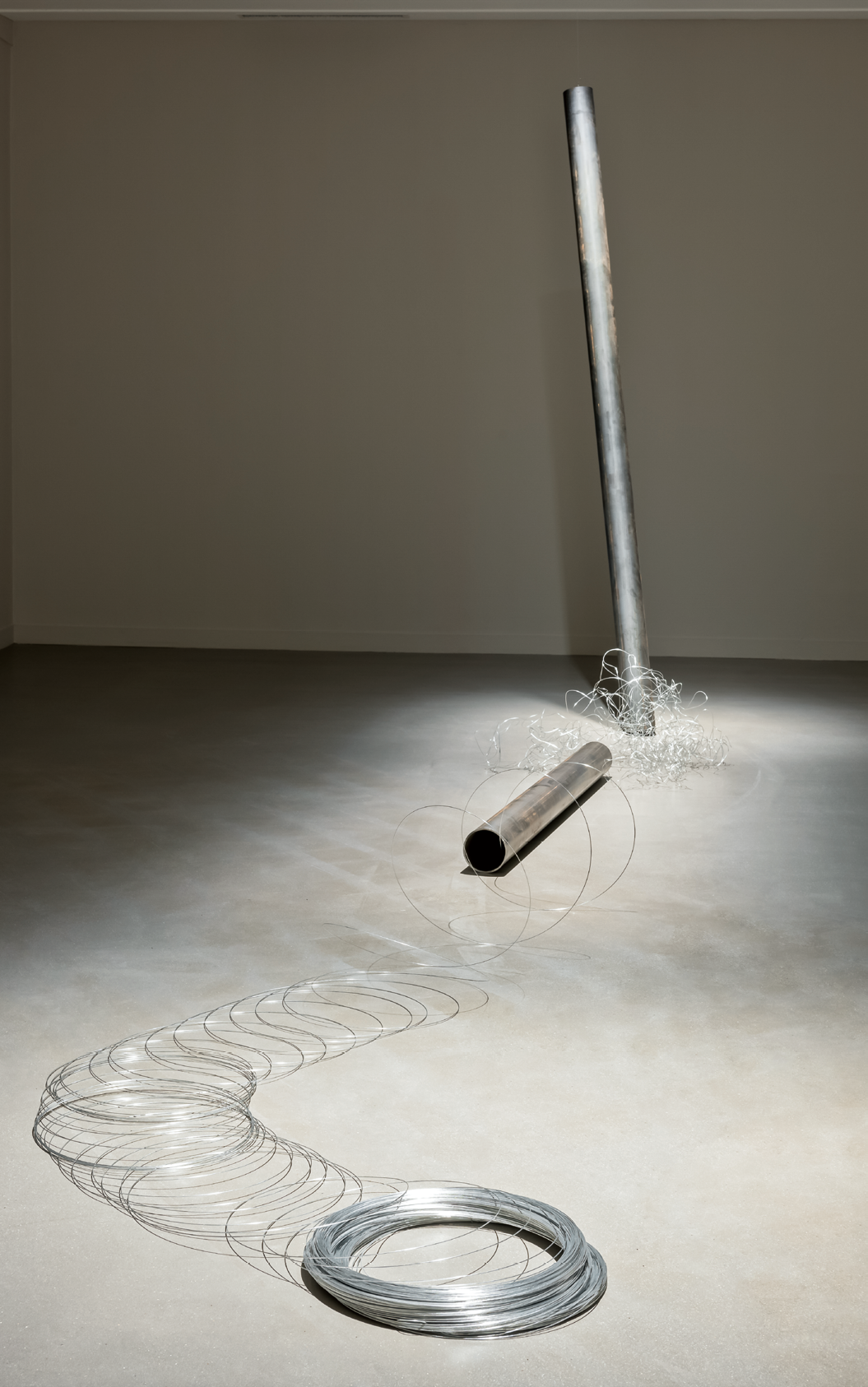
At this point it is possible to retrace the Journey to which Shim subjects the materials: paper, water, wood, stone, iron, terracotta will always relate, in terms of tension and relation, to the substance of the form, the substance of the sculpture. To Shim sculpture is above all a metaphor of the journey made by the material, through the simplest forms. The very fact of removing small parts of material, as for instance in the works in wood, is achieved through a repeated gesture that links these surfaces to a presence as fluid as water.
The 8th Paris Biennale, 1973, Paris, France
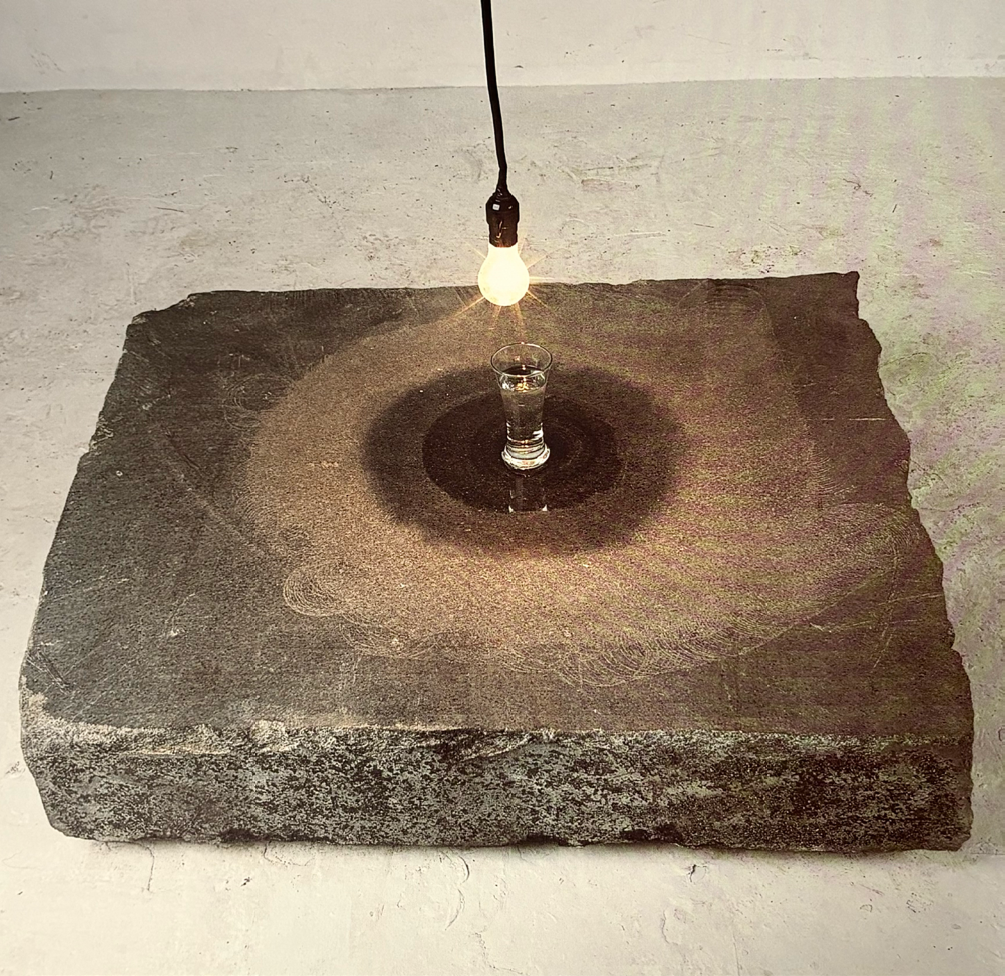
The Presentation, 85x28x85cm, 2001, Stone, Light, Glass
It is this extraordinary ability to pass from one material to the next that enables his works to co-exist with a dual glance, which observes the West from an Eastern standpoint. This is a starting point, a perspective that the Korean artist never abandons: even the titles of his cyclic works suggest a continuously moving glance. But Shim is a sculptor and a moving eye is, to him, a way to measure the space. However, this constructed space, organized by the material, does not only belong to a time originating beyond every measure, because he dilates it to natural, cosmic horizons. Thus, in the condition of gravity characterizing his sculptures, the weight becomes a force of attraction that relates to abyssal and stellar centers at the same time. Shim does not assemble forms and objects, rather, he narrates the time of the form, leaving the object, which in his culture means less than a stone or a river pebble, aside. In his series Relations, Metaphors, Opening Up, Wood Deity. Thoughts on Clay, the movement is symbolic.
When using wood he aims for the symbolic condition of the material, for the poetry of sacred forests so predominant in the mythology and culture of his native country: in his terracotta works we perceive a way to reflect on its archetypal condition, where reflection and thought are immersed into the profundity of this history of the form and the material; In those made of Iron the material is folded horizontally and vertically to create a closed form as if content and container were to unite the secret of this knowledge; In his works in stone, finally, a true architecture of the archetype of constructive arrangement is achieved.
But Shim Moon-seup does not organize his sculpture cycles on the basis of a different repetition of a spatial or material form. In fact, all his sculptures appear first and foremost as a declaration of incessant love for the forms suggested by his materials. Shim follows the suggestions of the material, which take on shapes in relation to the space, and in fact, the verticality and horizontality of his forms reject all symmetry, taking on different positions every time, almost as if to unite suspense and equilibrium. It is impossible to retrace a banal representative aspect in his sculptures, because not only the material, but also the objects, the little paper board or the lamp acquire a formal condition which is only symbolic
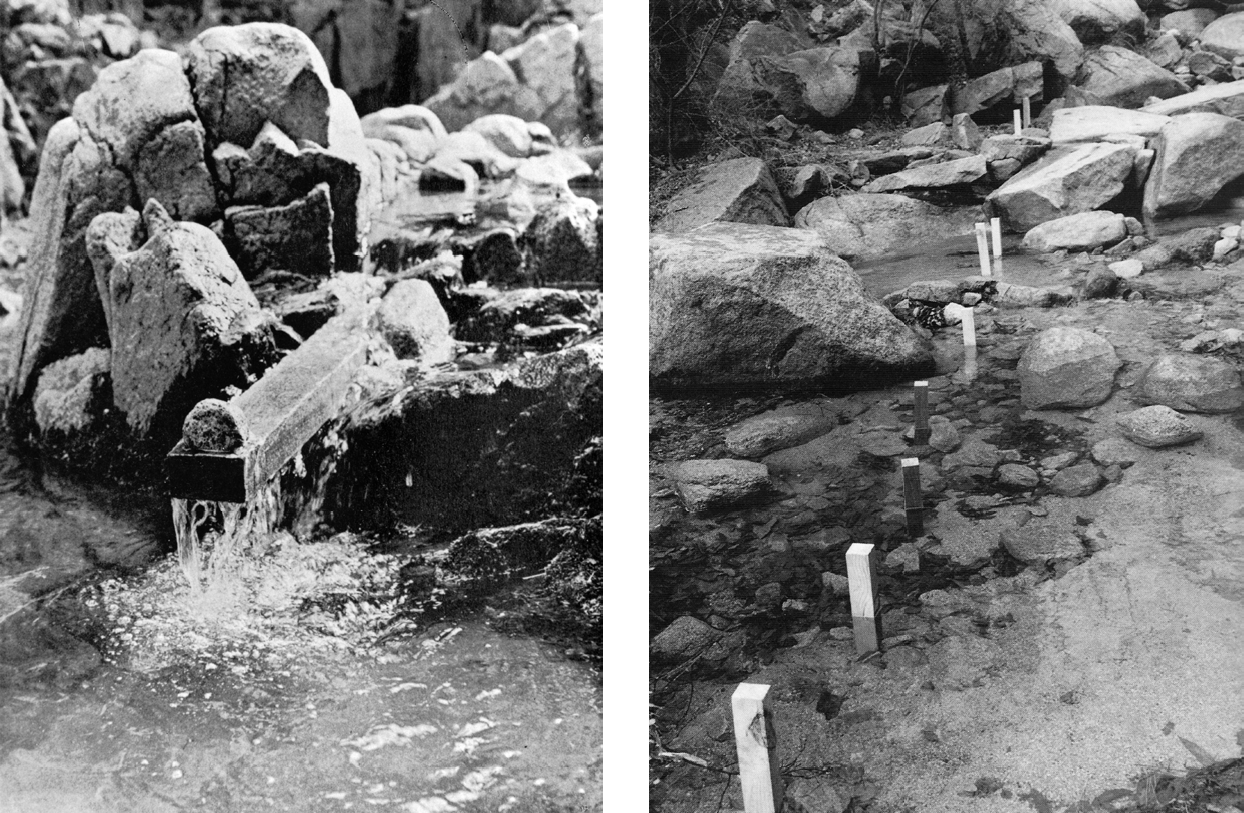
Relation, 1975, Valley, Wood
Relation, 1975, Valley, Wood
This apparent contradiction consists, through the indivisibility of the entirety of his sculptures, of volumes which, escaping the cure of formal representation, avoid both the historic and cursed trap of representation, and minimalist formalism and its exasperated and repeated geometric variants. Shim’s sculptures speak a single language, namely that of a universal sculpture which arrives at the formal roots of all relations between empty and filled space, between verticality and horizontality, between symmetry and asymmetry, recovering ‘the substance of the materials’ which accompany, tell and pronounce all the reasons to exist of sculpture, beyond time and space, beyond every figurative and abstract category, as if existing in a continuous Eurasian space which knows one word, and only one, for organizing and exhibiting its creative secret. And Shim is the master of that secret.
To Shim Moon-seup materials are words, and the formal organization of his sculptures is closely related to the double articulation of sentences, because by saying and pronouncing their name in this way, the materials assert the proposition of their raison d’etre as sculptural substance.
The message of Shim’s sculpture is, in my opinion, to be found in the completely new and singular idea of a thought, on the part of a material which thinks and is thought by the sculpture. Also the surface of his volumes reflect the play of this dual (but not ambiguous articulation. It is also a matter of reconsidering the order of the tactility in its sensorial condition, smooth and rough, which also historically marks a transition in the crafting of the materials, being united through a confrontation and reconciliation where the formal aspect, I repeat, is never representative but always metaphoric, complementary and open as if wavering between terrestrial and celestial, between the external and internal condition of the material.
Consequently, to Shim the
complementarity of opposites is expressed by
the nature of the materials, by their suggested
form; it is sufficient to consider his monumental
sculptures for outdoors to realize that the granite
volumes often rest on one another almost as if to
imply a mutual support (vertical and horizontal)
which relates to gravity in the simplest possible
manner. Shim triggers a kind of dominion of the
form in the material. However, this is a dominion
of direction, an indication of the path in the forest of forms, a meditation on the visible world and on the everyday objects which we live with, a metaphor to occupy the mind and the eye, by now impoverished by the images of representation and appearance. The functional beauty fades, reappearing in its full integrity, identical to an almost primitive identity which we may define sacred and primeval. Where the opposition between the nature of the forms and the forms of the spirit are reconsidered, as in the construction of a temple. It could almost seem as if Shim succeeds in uniting Martin Heidegger’s thought on sculpture “By virtue of the temple, God is present in the temple” with the idea expressed by Zen philosophy, of a temple understood as “Three doors and the main hall.”
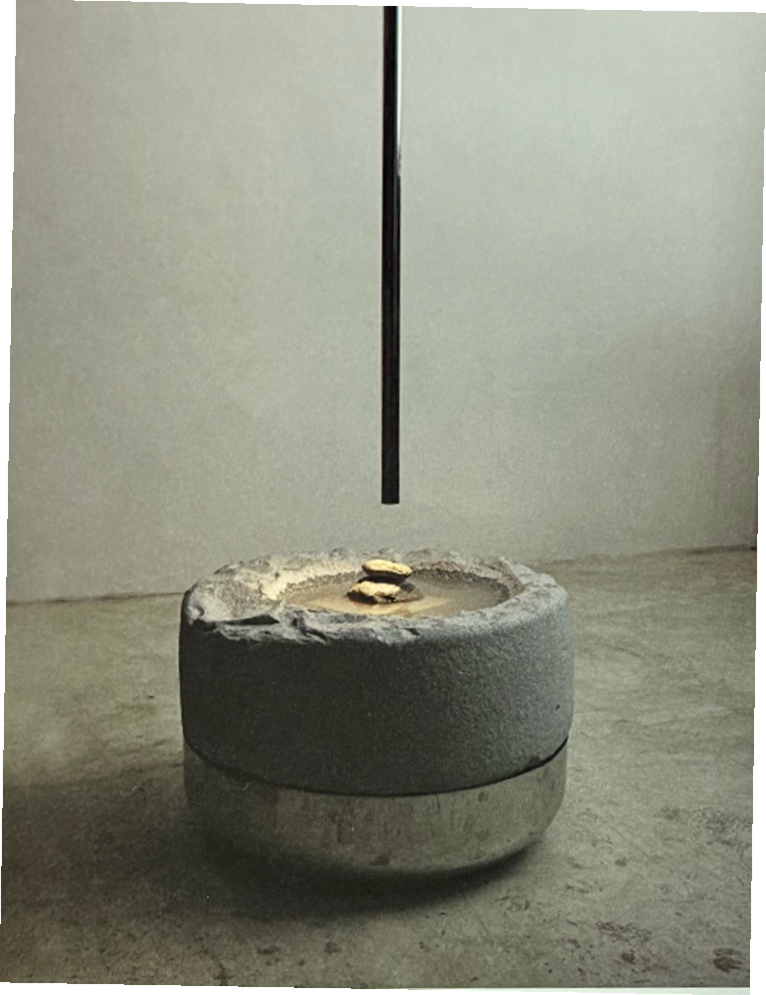
The Presentation, 110x225x110cm, 2008, Stone, Water
To Shim interior and exterior are solidary, complementary, in materials and forms. The temple is without and within the essence of being, the temple is the nature of the forms and the materials which may accommodate and unite within them the idea of a sculpture that lets abstract and figurative forms exist beyond the contradictions of contemporary sculpture, beyond the crisis of the plan and the drawing. The self-same crisis associated with sculpture proposing merely material and objective terms.
It is this primacy of objects, so characteristic of contemporary art, that his sculpture challenges.
To Shim Moon-seup materials are words, and the formal organization of his sculptures is closely related to the double articulation of sentences, because by saying and pronouncing their name in this way, the materials assert the proposition of their raison d’etre as sculptural substance.
forest, where he stages, among stone, water and wood, the metaphor of a single form, representing the myth of the creation of sculpture.
It is in this tale that the interior landscape of his country, where water and wood play the main role and where temples remain cultural bastions of the spirits of the forest, is revealed. With these landscapes, covered by a far-reaching glance, narrated by an interminable tale, touched by eloquent materials, Shim Moonseup maintains an infinite word, because the spirit of things cannot be but beyond the form and the word denoting it.
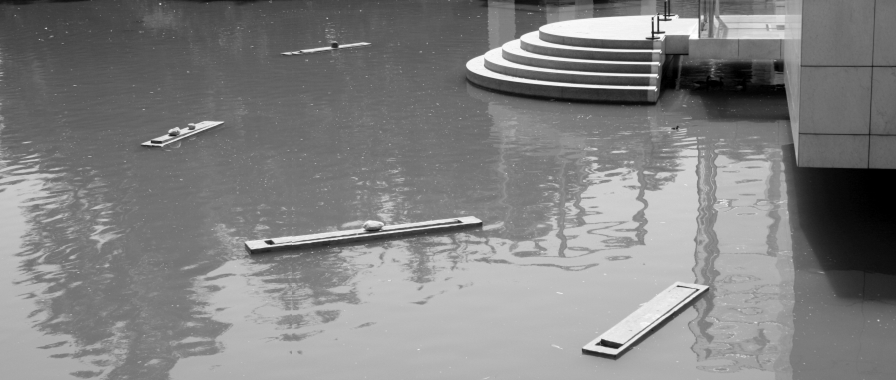
The Presentation to an Island, Musee Des Arts Asiatiques, 2008, Nice, France