About
Shim Moon-Seup is a pioneer of modern sculpture in Korea whose practice explores nature and temporality beyond fixed genres and media. He received international recognition with the Excellence Award at the 2nd Henry Moore Grand Prize Exhibition in 1981 and France’s Ordre des Arts et des Lettres (Chevalier) in 2007. Known for experimental anti-sculptural works, he challenges traditional sculpture through materiality, using wood, stone, earth, and iron. The Presentation, a painting series begun in the 2000s, extends his long-standing inquiry. Inspired by the sea of Tongyeong, repetitive brushstrokes evoke cycles of creation and destruction, reflecting the temporality of matter while blurring the boundary between sculpture and painting.
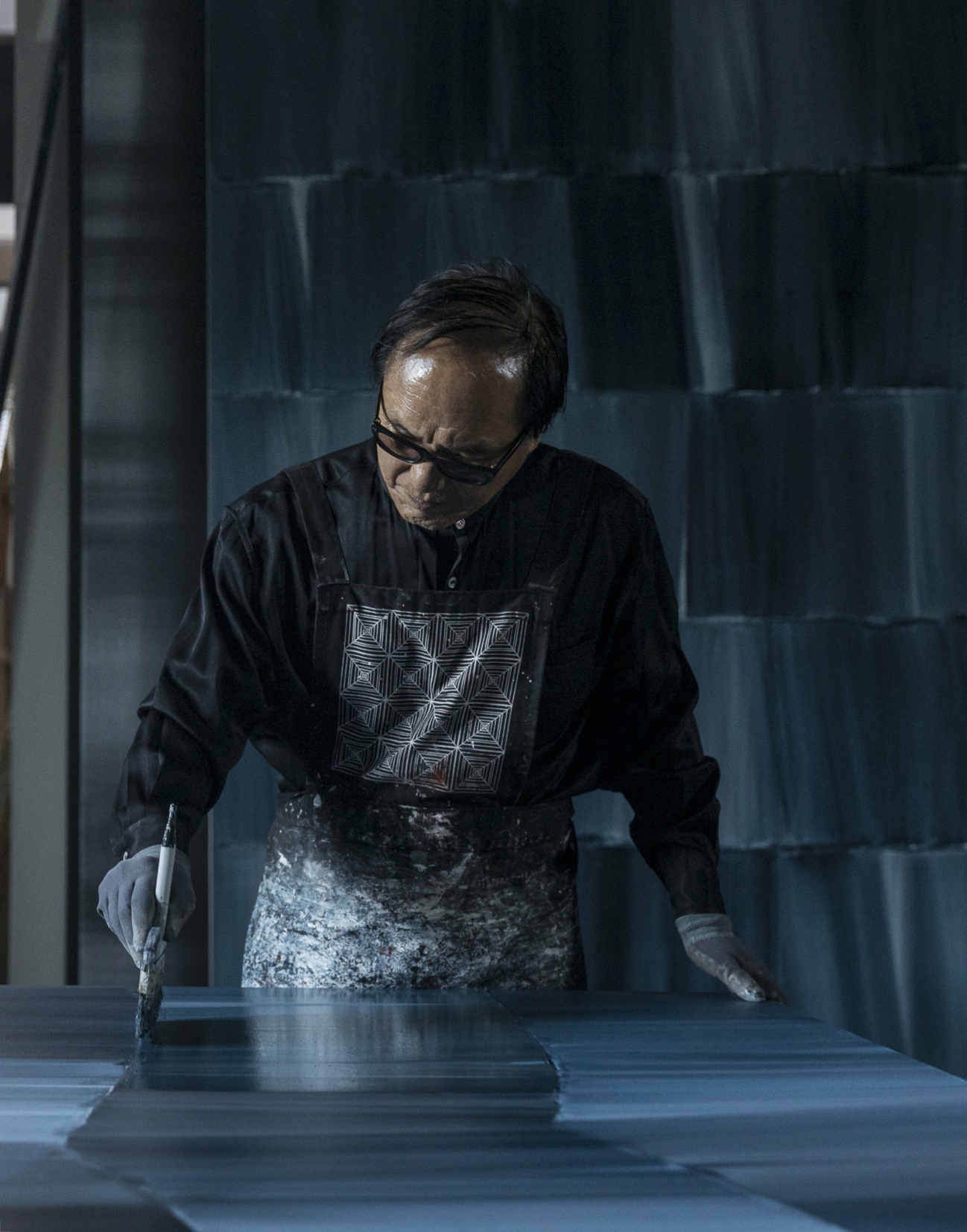
Shim Moon-Seup is widely known for his experimental anti-sculptural works that emphasise materiality and challenge traditional notions of sculpture by using materials from nature as objects, including wood, stone, earth, and iron. “The Presentation,” a series of paintings that began in the 2000s, is a new endeavour and an extension of the artist’s half-century-long artistic career that has taken him between France and Korea. The repetitive brushstrokes metaphor an infinite cycle and present the possibility of new life. The series of paintings derived from the seascape of Tongyeong, the artist’s hometown, expresses temporality at the point of ‘infinite brushstrokes’ and ‘infinity of the sea’. The endless repetition of creation and destruction is also connected to the inner images, experiences, and memories that the artist reflects on through his work, and the process of asking questions and seeking answers through them. “The Presentation” goes beyond the genre distinction between sculpture and painting and is a work about the temporality of matter and the process of embedding it, which the artist is constantly pursuing.
Shim Moonseup has been a central figure in the Korean Avant-Garde (AG) art movement since the late 1960s, redefining the ontological conditions of sculpture through the radical concept of “anti-sculpture.” He has critically dismantled the modern sculptural view that understands sculpture as the product of a completed form, instead proposing the relationships among material, space, and time themselves as the core of sculptural practice. This line of inquiry resonated with contemporaneous international movements such as Mono-ha, Arte Povera, and Land Art, while expanding into a distinctive sculptural language grounded in Eastern philosophical thought.
Shim Moonseup entered the international stage early through participation in major biennales, including the Paris Biennale (1973, 1975), the São Paulo Biennial (1975), the Sydney Biennale (1976), and a collateral exhibition of the Biennale di Venezia (1995). Invited by the French Ministry of Culture, he became the first Korean artist to present a solo exhibition at the Jardin du Palais-Royal in Paris (2007). Over the past half century, he has sustained a continuous sculptural practice through solo exhibitions at museums and institutions worldwide, including Fondazione Mudima (Milan, 2001), the Nice Asian Art Museum, the National Museum of Modern and Contemporary Art, and Perrotin Gallery (Paris, New York, Hong Kong). The Excellence Prize at the 2nd Henry Moore Grand Prize Exhibition (1981) and the conferment of the Chevalier of the Ordre des Arts et des Lettres in 2007 stand as symbolic milestones marking the international institutional recognition of his work.
Education
1965 – B.F.A. Department of Sculpture, Seoul National University, Seoul, Korea
Awards
2009 – The 8th Moonshin Art Awards
2007 – Ordre des Arts et des Lettres, Grade Chevalier (France)
2002 – Korea-France Cultural Award
1987 – The 1st Sejoong Kim Sculpture Awards
1981 – The 2nd Henry Moore Awards, Excellence Award
1971 – The 20th Korea Arts Exhibition Awards, Speaker of the National Assembly Award
1970 – The 1st Korean Art Exhibition Award, Excellence Award
1969-70 – The 18th-19th National Exhibition, Minister of Culture Department Award