The lonely horizon
Francois Michaud, Art critic, France Chief Curator of National Museum of Modern Art
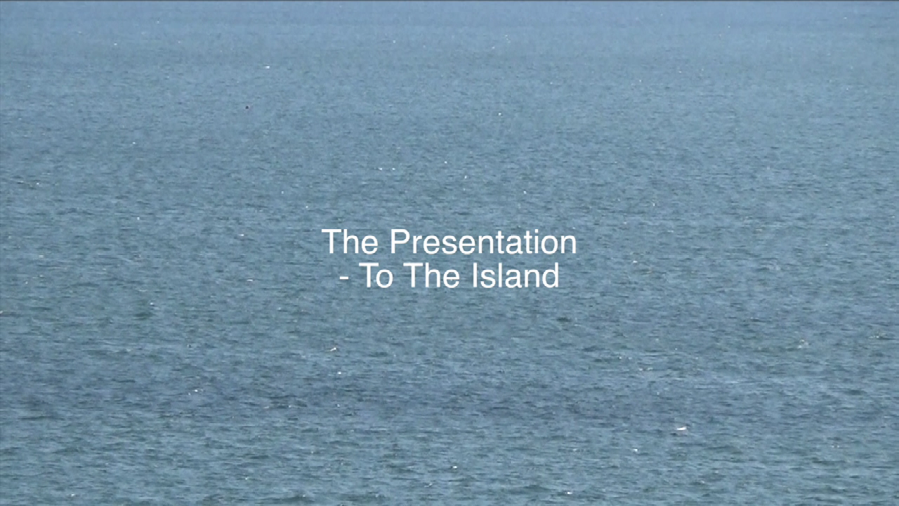
At the Paris Biennale, between 1971 and 1975, two artists with a common interest in wooden barres were able to cross paths: Shim Moon-Seup and Andre Cadere. They most likely did not meet, although the Korean artist may have seen the young Romanian, who had been living in Paris for a few years, in a gallery, recognizable as he was thanks to the round wooden barre he carried around on his shoulder at openings – a barre that he simply referred to as “his work” from 1972 onwards. Shim Moon-Seup never attempted to display his work in this way. Wood was one of his favorite materials, and he used it to create large, heavy pieces from a single block. The provenance of these pieces (a tree trunk) is still recognizable. I was able to see some of these cylindrical posts presented vertically in his Parisian studio, including one of his most impressive series known as Re-present (2010). With this title, the artist was stressing that his work from the 1970s – some examples of which were shown in Paris – and his current productions, mainly larger scale installations but along the same lines, were animated by the same drive.
Sometimes the barre is made of iron instead of wood, but perfectly circular, and placed against a wall. The careful arrangement of this heavy element makes its weight almost visible, while preventing it from falling and enabling an equilibrium; thus, it captures the audience’s attention not as a heavy object but rather as a kind of gravity-defying suspension, the near verticality of which contrasts with the fuller horizontal shapes, made from materials. This same barre – or its principle – is used by the artist in several of his installations and arrangements … How should they be referred to? Bearing in mind that this sculptor – and painter – came to the West early on, we should have no hesitation about using our own vocabulary, the words critics use without even thinking twice about it. However, a basic familiarity with this Eastern art form – which I first discovered as a young curator training at the Modern Art Museum of Saint-Etienne, when this museum hosted an exhibition for the Mono-Ha group – leads me to believe that our words remain too limited and neither exactly render what Shim Moon-Seup did, nor what he wished to convey.
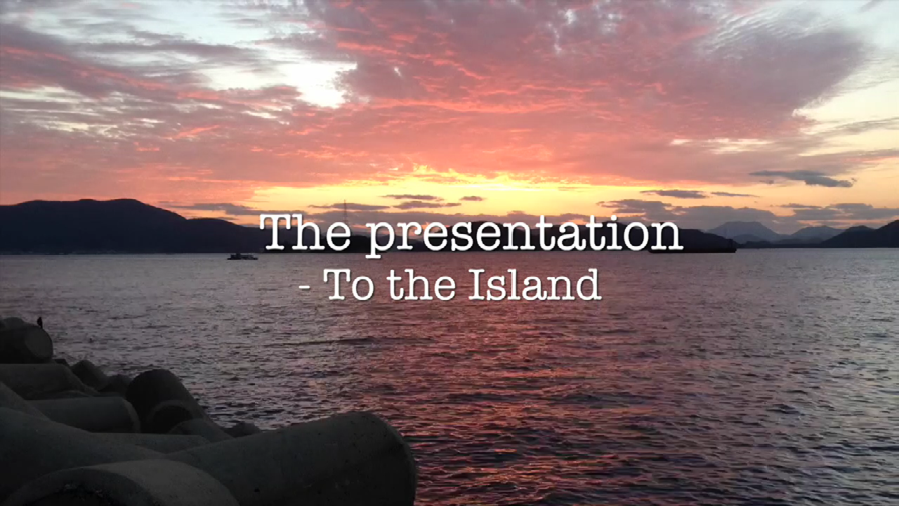
Let us return to the retrospective journey we had embarked on in the artists Parisian studio, devoted almost exclusively to his painting. After all, this might tell us just as much about the sculptor’s work than about painting itself. For Shim Moon-Seup, painting and sculpture are not opposites, no more than the long shapes he applies vertically or horizontally onto the canvas oppose the lines of ancient calligraphy: painting and ink – Shim Moon-Seup’s painting contains dark colors, subtle shades of near-black grey, with an occasional burst of color. These panels are designed to be joined together: large polyptychs made from canvases stretched over very large frames. Once again, references come to mind, ideas for possible links and connections, but we quickly discard them – not simply to deny the commonplace that any artist draws inspiration from the work of his contemporaries and of his elders (such correlations are frequent in art), but because the creative process dissociates beginnings from endings. For an artist born by the sea and for whom that reference (the horizon) is so present, it is valid that painting might not have a term: “endless painting” (the word is Cadere’s but others have used it), because it must always be renewed, in the same as it is possible to erect a pole, then another, and another to form what we refer to as an installation – but why not simply use the old term: sculpture? In his threedimensional work and in his painted work alike, using perfect regularity and precision, Shim Moon Seup seemingly pursues the quest for an element that cannot be named. A point of balance, perhaps, like several poets or painters admitted to be searching for, from Andre Breton to Zao Wou-Ki, evoking both the relationship between this point and the dream. Not fiction – that would be reintroducing discourse, narrative, speech … No, rather a certain state of being and an agreement between what we have inside us, and that we believe we possess – this fleeting feeling of the moment that binds us to reality – and another dimension; is it spiritual or is it simply distinct? The question that arises repeatedly when one encounters a work that rejects imitation or representation of the figure (anything that is anecdotal), is the question of abstraction. Again, these are words that are difficult to manipulate, similarly to an imposing tree trunk: one does not know how to grasp it nor if our arms will suffice to lift it off the ground. However, we do know that this word means something. A moment ago, we were discussing horizons … might it be a vertical horizon that Shim Moon-Seup was seeking to pursue and to reconstruct, using other means than that of the image? Let us take a moment to look at his photos: this one especially, seen from the sky, where a boat traces a path through the water, which is transformed into a pure grey surface – this type of photograph is not made for color, it gives us a sign.
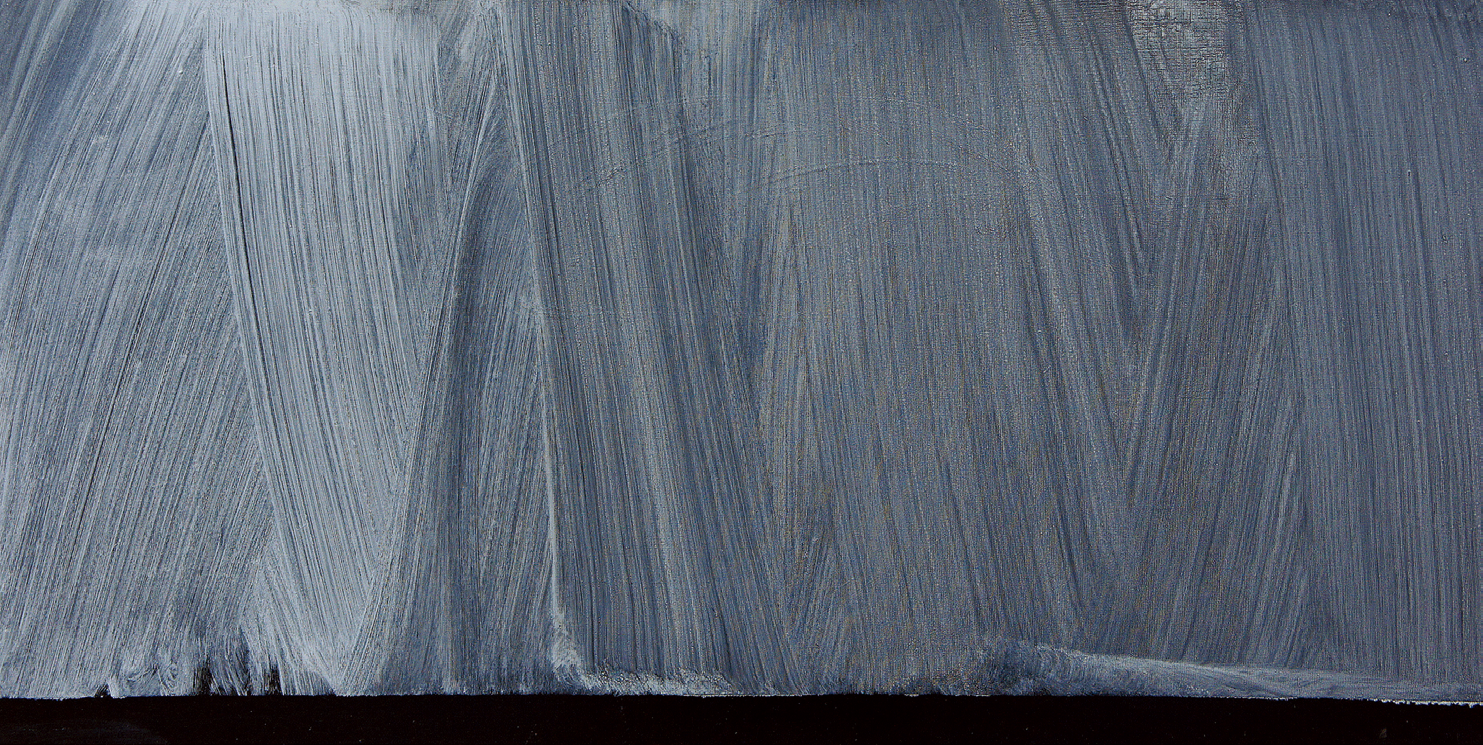
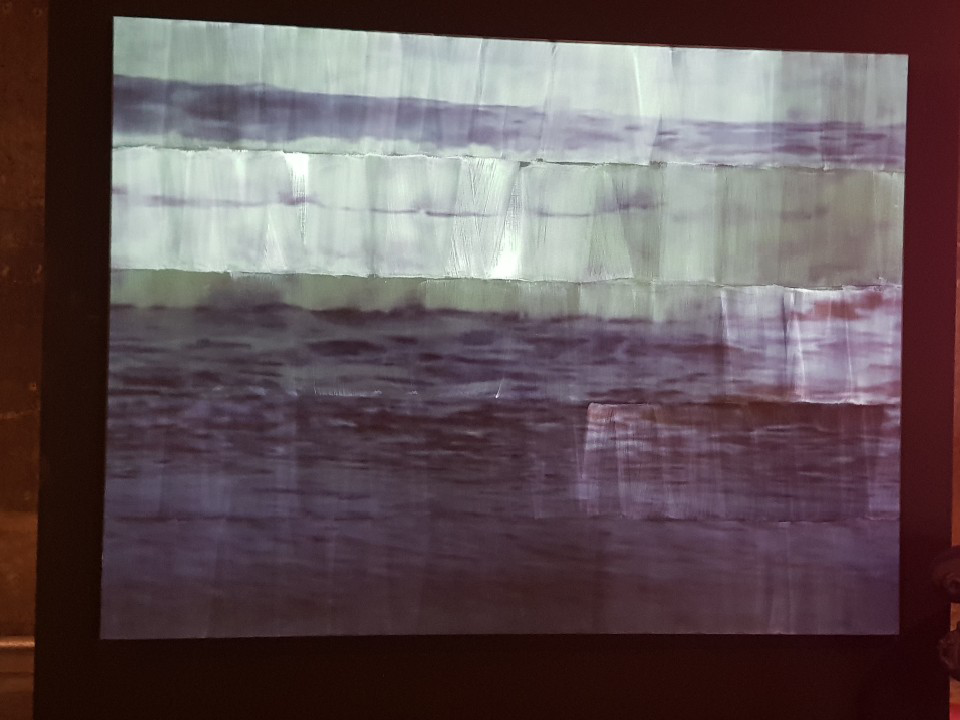
The Presentation-To the Island, 60x120cm, 2012, Acrylic on Canvas
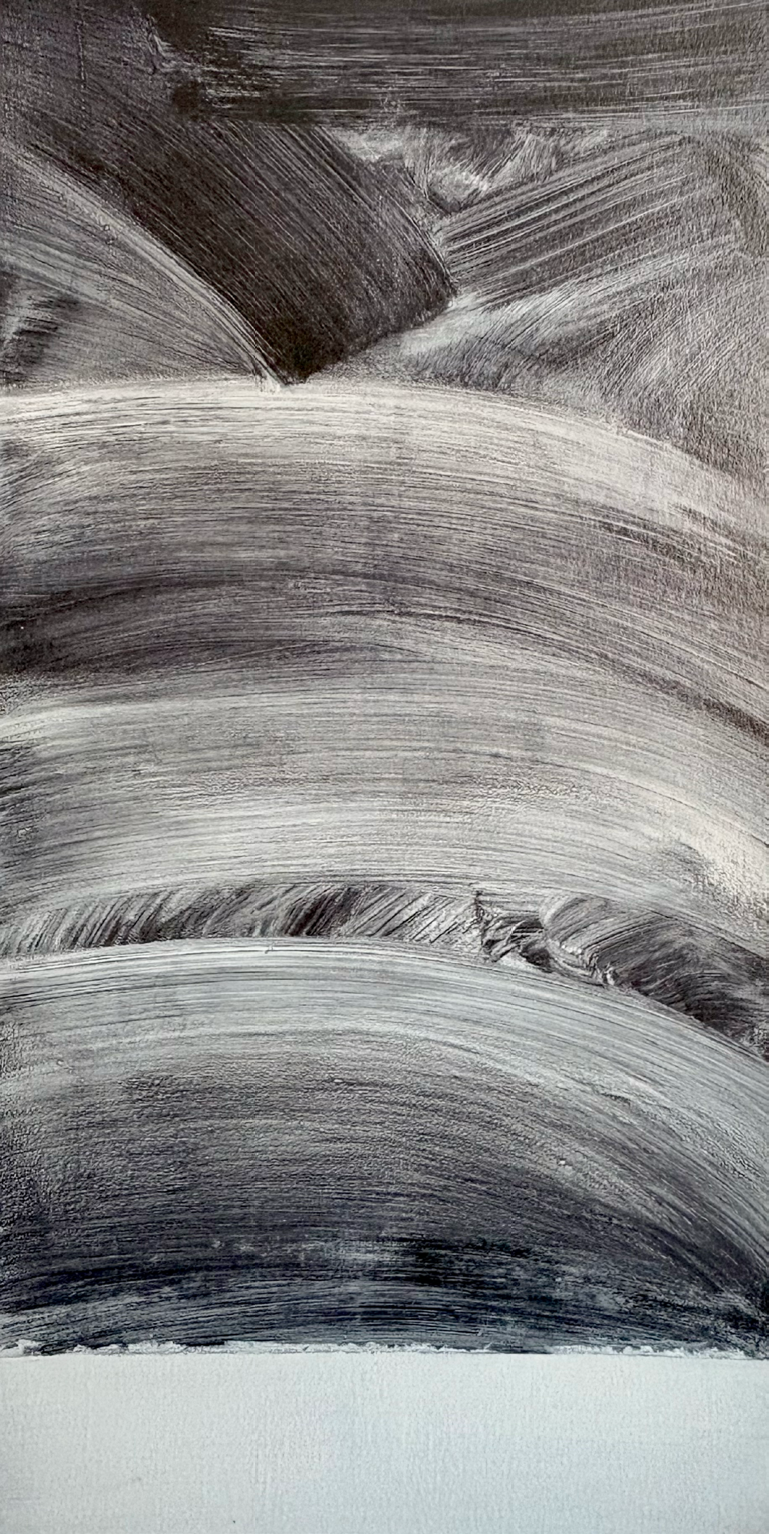
The Presentation-To the Island, 120x60cm, 2012, Acrylic on Canvas
So what is this sign? Could this be what the artist was already seeking in his early pieces from the 1970s, made of simple assemblages, or rather relations – a sign that would, however, not be significant? We must beware, while mentioning signs, as to what they imply in a culture of the ideogram. The relation, in this case, is too simple, too direct, too Western. Yet we all use signs. We use them without even thinking about it. Now, is the abstraction of signs not precisely this isolation of simple elements, reducing them to a barely transformed form? Shim Moon-Seup used earth and stone alongside wood and metal to make “compositions”. One is tempted to write: “re-compositions” to recompose reality by partly extracting a material from its environment, selected among the primary elements that pre-exist all forms, and to make these elements a non-language: a combination of signs, simpler than those that make up a language, but thanks to which we know how to find each other and to identify ourselves.
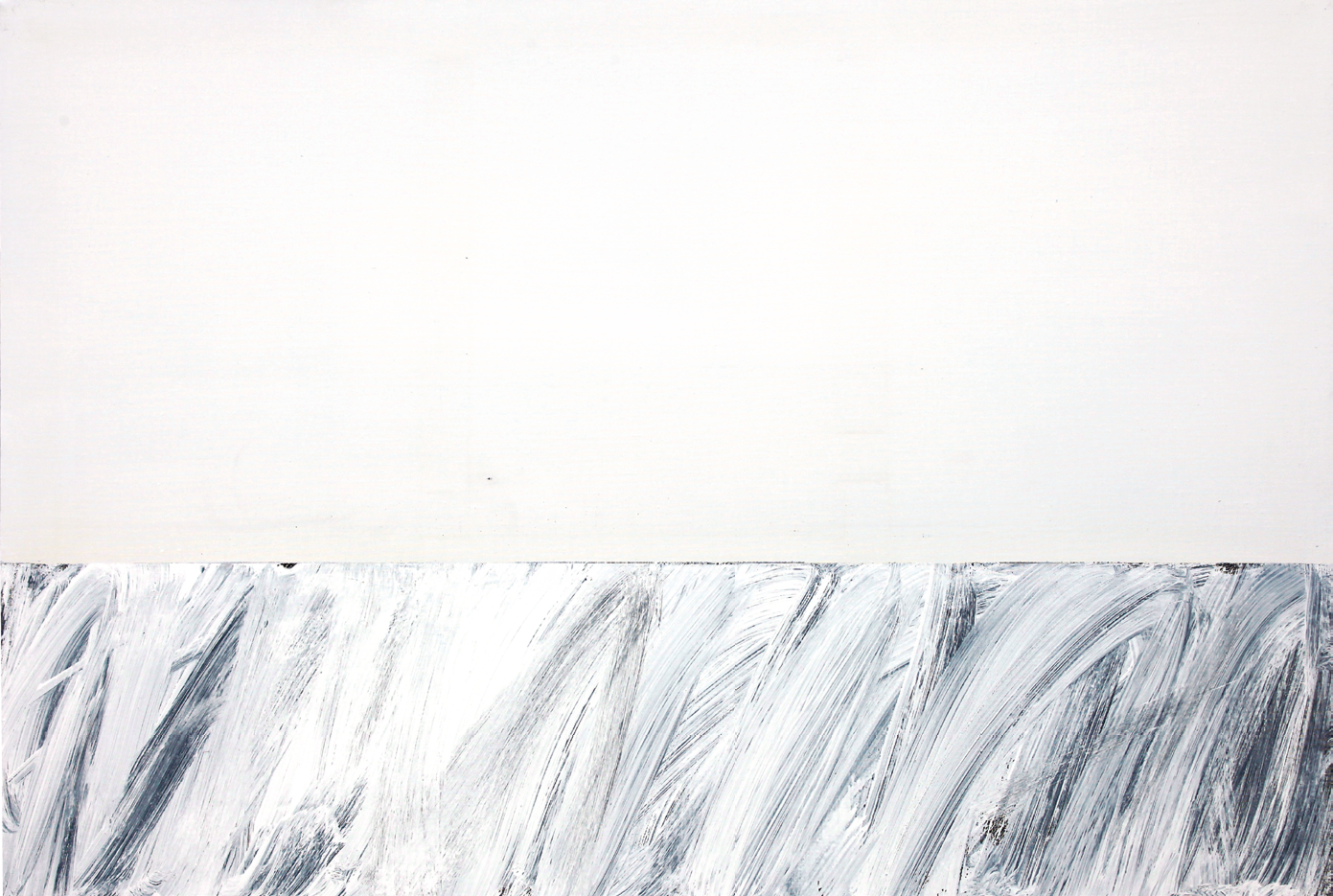
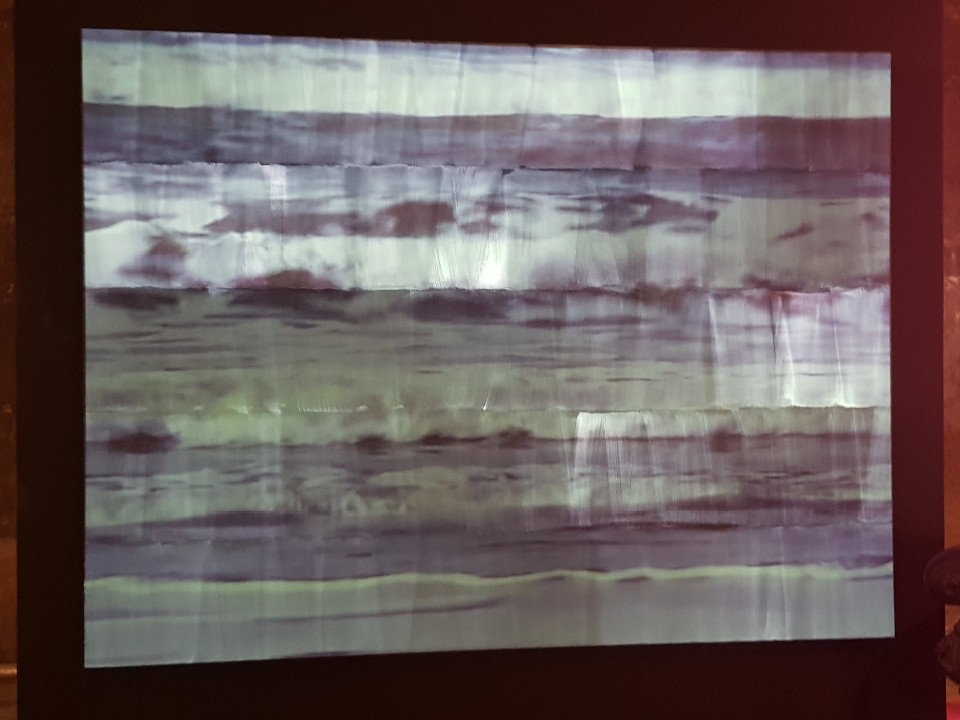
The Presentation-To the Island, 120x60cm, 2012, Acrylic on Canvas
The forms laid on the ground, the vertical pieces of wood, the slanted horizons in his painting and photography are all able to furnish the material with an expression that is both evident and complex. The evidence is that of the material. Complexity, however, is unavoidable: in the distance between the author and his work, between the sign and its projection into space; distance between the starting point – with all its sensations and memories – and the point of arrival. The distance is greater still, and far more perilous, between the one who acts and the one who observes, with, between them, this fragile thing that is a “work” – even when its format emphasizes it. Will it be understood? Can it is? Will it merely be perceived? Can the beginning of an understanding emerge between the author and the observer?
But when there is no common language, when the words we exchange are poor, poorer than expressions: a look, a smile, a perplexed look … then only the work resumes its value as a sign and condenses in itself a whole narrative element which cannot be uttered, which never will be uttered and which, nevertheless, is already entirely present, always re-presented.